Saturday, November 21, 2015
Armidale's a day on the green
Mind you, it was hot. Armidale may be known as Balmydale for several reasons, but one is definitely the normal summer climate. But this time! Not as hot as its been elsewhere during the current heatwave, mind you, but at 33c still very hot. You would definitely have needed a hat.
Promoted by Roundhouse Entertainment, a day on the green began in Victoria with a first show on Australia Day 2001. Now a day on the green runs in the summer months from October – March with around 30 concerts per season in major wine-growing regions around Australia.
Before going on, local State MP Adam Marshall was clearly enjoying himself!
In addition to the Petersen's Armidale wine gig, there are two other vineyards with New England connections, Bimbadgen Wines at Pokolbin, Sirromet Wines in the Queensland Granite Belt.
It's remarkable how few people realise that Queensland's Granite Belt is actually the most northern part of the New England Tablelands. That border really creates a very peculiar myopia!
Both Bimbadgen Wines and Sirromet Wines host more events than Petersen's for a very simple reason.
Pokolbin is about two hours from Sydney, attracting visitors from there as well as Newcastle and the Lower Hunter. Stanthorpe is about two and a half hours from Brisbane.and attracts visitors from there as well as the Darling Downs. Unlike Pokolbin which competes with Orange and Mudgee as well as Canberra area vineyards, Stanthorpe has the South East Queensland market to itself.
While smaller, the Armidale event is now drawing people from across Northern New South Wales, making for a considerable crowd.
Wednesday, October 29, 2008
New England Stories - the Hunter Valley Drayton's recovery from tragedy

Photo: The explosion at Drayton's. Inset Trevor Drayton, one of the two who died.
At 8.15 am on the morning of 17 January 2008, a huge explosion ripped through the cellar building at Drayton's family wines in the Hunter Valley. Click on photo for a link to the story.
Growing up, Hunter Valley wines were the wines I learned to drink, New England's best. After 150 years, the Draytons were one of the best known wine families.
Earlier this week the ABC TV program Australian Story carried an episode on the fire and its aftermath. The main link is here, the transcript here.
The episode is partly a love story, of the relations between the assistant wine maker at Drayton's, William Rikard-Bell who sustained burns to 80 per cent of his body, and his partner, Kimbereley Booker.
It is the story of the Drayton's fellow wine makers who, while competitors, gathered together to ensure that the Drayton's 2008 vintage could be harvested and turned into wine. And it is the story of the Draytons themselves.
The story reduced me to tears. I thought that it was one of the most moving pieces of TV that I have seen.
Saturday, July 26, 2008
New England - Northern Tablelands Wine Region
I have drawn this map from the New England wine site. It shows the boundaries of the new GI area. The site contains a range of useful material on this re-emerging wine region. Sunday, January 27, 2008
New England Tablelands achieves GI wine status
Back in August 2006 I looked briefly at the early history of wine growing on the New England Tablelands and Slopes. From early beginnings, grape and wine production grew rapidly only then to vanish, re-emerging in recent years. Now in the next stage of the industry's development, the Tablelands and immediate slopes have achieved GI status under the "New England Australia" label.
GI, short for Geographical Indications, is the official system by which Australia's different wine regions are recognised and protected. According to the Australian Wine and Brandy Corporation, the area's unque set of climatic conditions and similarities of topography, soil types and climate have earned the region its new status.
At 27,000 kilometres, the new region is one of Australia's largest and is presently home to 42 vineyards. The area's diverse conditions makes for considerable variety.
Postscript
According to the Inverell Times, local industy associations are planning an official regional launch at Armidale on 15 February, with a gala event at Parliament House in Sydney later in the year.
Saturday, December 30, 2006
New Northern Tablelands (New England) Wine Web site

Photo: Charles Whish, the Chair of Judges at the New England Wine Show in 2005 and 2006. Charles grew up in New England where his father, Keith, developed the Gilgai Winery near Inverell in the 1960’s. Charles is now head winemaker for Rosemount Estate in McLaren Vale, SA.
In searching, I found a New England wine site that I had not seen before. I think that it's in fact new because there are still some information gaps.
Called New England Wines Australia, the site aims to present the wines, vineyards and wineries of the Northern or New England Tablelands. I spoke of the re-emergence of this wine area in an earlier post. Readers who are interested can find a stocktake of my earlier posts on New England's wine regions here.
I wish the new site every success.
Sunday, September 24, 2006
New England Australia - Stocktake Food & Wine Posts 24 September 06

Photo: Petersons Winery, Armidale.
To help people access previous material, this post pulls together previous posts on food and wine in New England up to 24 September 2006.
Preparing this post reminded me that the second New England (Northern Tablelands) Regional Wine show will be held at Glen Innes from Wednesday 4 to Saturday 7 October.
The first days of the show are only open to exhibtors, judges and officials, with public activities on the Saturday.
Gourmet in the Glen will run throughout the day at the Glenn Innes showground and include tastings, wine and food sales and a cooking display.
There will be a public tasting of the wines entered in the show from 1 to 3pm. The day finishes with the Glen Grape and Gourmet Ball.
After this reminder, previous food and wine posts to this point are:
- 1 August 2006. New England Wine Regions - Hunter Valley. Short overview of this wine region and its history.
- 3 August 2006. Regional Australia & wine. History of wine in Australia. Linked post on the Regional Living Australia blog.
- 6 August 2006. New England Wine Regions - New England Tablelands and Slopes. Short overview of this wine region and its history.
- 10 August 10 2006. New England Wine Regions - Hastings Valley. Short overview of this wine region.
- 12 September 2006. Palmerston and Petersons Wines. Story about the transformation of one of New England's historic homes by Petersens into a new guest house adjacent to their Armidale vineyard.
Previous Stocktakes
- History: Historical posts up to 7 September 06
Tuesday, September 12, 2006
Palmerston and Petersons Wines
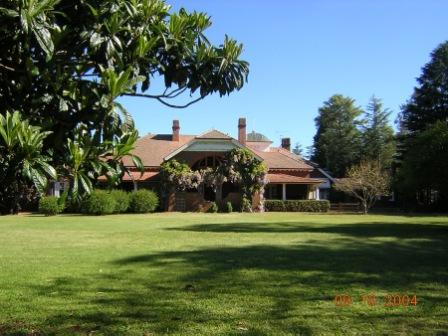
Photo: Palmerston, ArmidalePetersons Wines Armidale Winery and Vineyard has turned one Armidale's historic homes into a luxurious new guesthouse.
Palmerston was built in 1911 by members of the Dangar family, one of the pastoral dynasties that has left an indelible mark across New England's built landscape.
The Dangar dynasty was largely founded by Henry Dangar (1796-1861) supported by brother William.
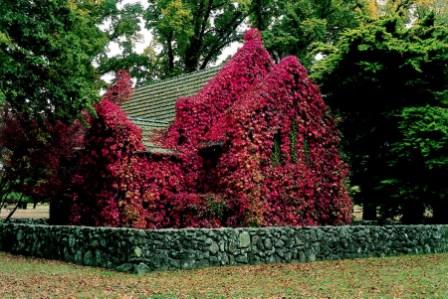
Starting from Neotsfield in the Hunter Valley near Singleton, Henry had acquired over 300,000 acres (121,407 ha) by 1850 spread across New England. This included Gostwyck near Uralla with its beautiful chapel (photo).
In addition to his pastoral interests, Henry acquired town allotments and established inns and stores along the Great North Road to the Liverpool Plains. At Newcastle he had boiling-down works and meat-preserving and tinning works, and in New Ze
aland he established a steam flour-mill near the wheat farms around Official Bay.Petersons, a family company already synonymous with quality, award winning wines, has restored Palmerston in line with its original architecture, retaining a historic element but offering contemporary conveniences, like wireless broadband access, heated floors and plasma television to create a unique boutique style getaway.
With seven spacious suites in a fully restored historic home, the guesthouse will cater for couples looking for a romantic and relaxing weekend away, corporate guests passing through Armidale on business, or guests who are in Armidale for a special occasion.
The two acres of gardens surrounding the property are heritage-listed and create a gorgeous view from the drawing room. Walk through the gardens, and you’ll find yourself at Peterson’s cellar door, where you can sample cool climate wines any day of the week. On weekends, you can enjoy a bottle of wine with a cheese platter, or a barbecue lunch on Sundays.Guest house manager Katrina George said the Guesthouse is designed to give guests the highest level of comfort in a relaxed, spacious and friendly environment.
“We think this Guesthouse is particularly unique to New England,” she said, “and we trust it will be a memorable experience for anyone who stays here.”
Location Details:
Petersons Guesthouse is at Dangarsleigh Road, Armidale about five minutes by car from the Armidale CBD.
Depending on the route you take, Armidale is around six hours from Sydney, five hours from Newcastle, three hours from Port Macquarie, around two and a half hours each from Coffs Harbour and Grafton, four hours from Lismore and four and half hours from Brisbane.
Phone Peterson’s Guesthouse on +61 2 (02) 6772 0422 or email: petersons.armidale@bigpond.com
Thursday, August 10, 2006
New England Wine Regions - Hastings Valley

The Hastings Valley region is located 390 kilometres north of Sydney, 557 kilometres south from Brisbane, around 230 kilometres south and east from Armidale.
Port Macquarie at the mouth of the Hastings River, now the largest centre with a population of over over 40,000, was founded in 1821 as a penal settlement. Wauchope, for long the Valley's main commercial centre, began as a timber centre and is the site of Timbertown, a major heritage attraction.
The first wines were planted in the 1860s. However, and as happened to the New England Tablelands' wine industry, wine production declined before re-emerging in recent years because of the influence of the Cassegrain family.
The family pioneered the use of the French hybrid and fungus resistant Chambourcin grape along Cabernet Frank, Cabernet Sauvignon, Merlot, Shiraz, Chardonay, Sauvignon Blanc and Semillon. Today the Valley has a number of vineyards.
The combination of quality wines, cellar door facilities, music events, good regional restraurants with surf and other coastal attractions are all building interest in the Hastings' wine industry. Wine Diva provides further information for those who are interested.
Sunday, August 06, 2006
New England Wine Regions - New England Tablelands and Slopes

The second Regional New England Wine Show will be held at Glen Innes in the first week of October 2006. In addition to Tablelands' growers, winemakers from adjacent viticultural areas - Hastings, Northern Slopes outside New England, Western Plains and the Queensland Granite Belt will also be exhibiting.
While the New England Tablelands and adjacent slopes is today classified as a new wine producing region, it is in fact a re-emerging region with a long history.
In my post on New England Wine Regions - Hunter Valley I spoke of the role played by George Wyndham in establishing the Hunter Valley wine industry. I also mentioned that in 1831 he brought the 100,000 acre property "Bukkulla" near Inverell on the edge of the Northern Tablelands and there established another vineyard. Other settlers also planted vineyards and made their own wine.
By 1870 George had 10ha of vines bearing fruit which contributed to the total 11,000 gallons of Wyndham Estate wines being produced. By 1905, wine production from the Inverell area of New England was 227,000 litres from seven or eight larger vineyards and a number of smaller vineyards.
Between 1870 & 1920 wines from the area won many awards at wine shows in Sydney, Amsterdam, London, San Francisco, Chicago & France. A prominent English wine judge of the time wrote of the Bukkulla wines, “(They) have a character and quality above the average of most wine-producing countries. The lowest quality is better than a large proportion of the ordinary wines of Europe, while the best would not suffer in comparison to the finest known growths”.
Thereafter wine production went into decline, re-emerging over the last ten years.
The New England Tablelands area is unlike any other grape growing region in Australia because of its diversity. Vineyards range from cool climate vineyards along the spine of the Great Dividing Range(a good number of vineyards are above a 1,000 metres) to the lower and warmer sites on the western edges of the New England Tablelands.
Wine Diva provides an excellent source of information for those wishing to find out more.
Tuesday, August 01, 2006
New England Wine Regions - Hunter Valley

Located approximately 160 kilometers north of Sydney with a population of around 700,000, the Hunter Valley is New England's best known and Australia's oldest wine growing region.
In 183o George and Margaret Wyndham purchased "Annandale" in the Hunter Valley, renaming the property "Dalwood" and building Dalwood House as a home.
In 1828 George had planted his first grapes using 600 cuttings purchased from James Busby. Following the purchase he immediately made the first commercial planting of shiraz at "Dalwood". Then in 1831 he brought the 100,000 acre property "Bukkulla" near Inverell on the edge of the Northern Tablelands and there established another vineyard.
The first "Dalwood" vintage produced in 1831 was not a great success which due to the "extremely hot conditions promised to make good vinegar." Thereafter wine growing expanded rapidly. By 1860, Wyndham's total holdings were producing 11,000 gallons of wine.
The story of these early days can be found in The Generations of Men (Oxford University Press, 1955) by Judith Wright, one of Australia's best know writers and herself a member of New England's Wyndham/Wright pastoral dynasty. "Dalwood" itself is now the home of Wyndham Estate Wines.
The Hunter Valley offers great variety in scenery and activities.These range from the surfing beaches around Newcastle to the mountain country of the Barrington Tops to the Myall Lakes to the open rolling country of the Valley itself.
The Valley is relatively compact in geographic terms.This allows visitors to easily experience a range of scenery and activities. However, time needs to be allowed if you are to really enjoy the variety of wine tasting opportunities!
There are a number of wine growing areas within the Valley, with vineyards ranging from major commercial enterprises to small boutique operations. It's not really possible to visit them all, so you need to plan your trip.
There are many Hunter Valley web sites. One of the best from a wine and food viwepoint is http://www.winecountry.com.au/. Another general site is http://www.huntertourist.com.au/.
Many of the vineyards have their own sites as well.