Showing posts sorted by relevance for query New england Airways. Sort by date Show all posts

Tuesday, October 24, 2006

New England Australia - Stocktake on Transport Posts 24 October 06

This stocktake provides an overview of posts dealing with the development of transport within New England.

Previous Stocktakes

Saturday, April 07, 2007

New England Airways - two more photos

My thanks to Bruce Robinson for sending me some more photos of New England Airways, New England's first major airline. For those interested in the history of New England Airways, a list of previous posts on NEA can be found at the end of this post.

I normally compress photos to save space and speed loading. However, if I load the full photo you can then see the detail by clicking on it, so that is what I have done in this case. Later: This does not appear to work in this case. Not sure why.

Photo: The following photo shows a Shell tanker fuelling the Ryan. Bruce advises that the vehicle is a Crossley and was converted from the limo that was used by the Duke of Gloustershire during his visit to Australia.The guy in the seat of the Crossley was Ralph Virtue (Keith's brother) who was killed in the Puss Moth crash near Byron Bay.


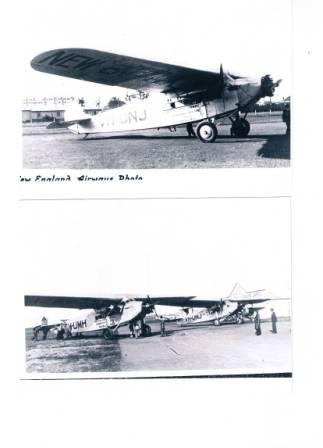
Photos: The first photo shows the Ryan outside the NEA hangar, the second shows a Stinson flying over Sydney.


Previous Posts

11 September 2006. New England Australia - Aviation introduces the story of the founding of New England Airways by George A Robinson.

12 September 2006. New England Airways - Postscript provides access to some very good early photos of NEA passengers.

14 September 2006. New England Airways - Follow Up contains some further musings plus photos.

17 October 2006. New England Australia Aviation Pioneers - the Virtues introduces another pioneering New England family closely associated with the history of New England Airways.

4 January 2007. Transport Pioneers - The Robinson Family; a further note outlines the early story of the Robinson family as transport pioneers in the Macleay Valley.

Saturday, October 14, 2006

New England Airways - Follow Up


Photo: New England Airways, Avro10s, photo courtesy of Bruce Robinson.

While this blog has a historical focus, one of the nice things about it is that I am not bound by the canons of academic discipline. Yes, I do try to observe proper standards, but because I do not want an academic career (it's a bit late for that!), I do not have to subject myself to the whole rigmarole. I can go where I like.

My aim when I started was to capture and document the New England experience before it was lost, hopefully drawing others in. I am starting to get there.

In earlier posts I spoke of New England Airways (here(1) and here(2)).

I first came across a reference to New England Airways back in 1982 when I was doing my PhD thesis. I was fascinated. I knew Don Shand and the story of East West Airlines (story), but I had never heard of New England Airways. Yet here was a pioneer airline of some substance holding the Sydney-Brisbane mail contract that had somehow vanished. I could not do anything about it at the time, so put it aside.

When I launched this blog and came to write something for the first time on New England aviation I made finding out something about New England Airways my first priority. While the on-line historical record was skimpy it did allow me to fill in some gaps. In turn, this led Bruce Robinson, the grandson son of New England's founder George A Robinson, to contact me. Now we may be able to fill in some gaps.

Does this matter? I think that it does very much and not just from a New England perspective.

Today when airlines are the bus lines of the sky, we forget the romance and the physical and commercial risks associated with this early period. Nevile Shute, one of my favourite authors, brings this early period alive in many of his books. New England Airways was a major player in this early period and deserves to be remembered for that fact alone.

Monday, September 11, 2006

New England Australia - Aviation


Photo. New England Airways Avro parked at Archerfield, Brisbane c 1933.

New England has had more than its fair share of pioneer aviators. Unfortunately, like so much of New England's history, this has become submerged in the mists of time.

When I started at TAS (The Armidale School), a former senior prefect Sir P G Taylor was one of the school hero's.

Taylor was involved with flying since at least 1916. Perhaps his most famous exploit came in 1935. The story that follows is drawn from Keith Isaacs' ADB entry on Taylor given in the previous link.

Taylor was Kingsford Smith's navigator in the Southern Cross for the King George V jubilee airmail flight (Australia-New Zealand). After flying for six hours, the heavily-laden aircraft had almost reached half-way when part of the centre engine's exhaust manifold broke off and severely damaged the starboard propeller. 'Smithy' closed down the vibrating starboard engine, applied full power to the other two, turned back to Australia and jettisoned the cargo. The oil pressure on the port engine began to fall alarmingly.

Climbing out of the fuselage, Taylor edged his way against the strong slipstream along the engine connecting strut and collected oil from the disabled starboard engine in the casing of a thermos flask. He then transferred it to the port engine. With assistance from the wireless operator, John Stannage, he carried out this procedure six times before the aircraft landed safely at Mascot some nine hours later. For his resourcefulness and courage, Taylor was awarded the Empire Gallantry Medal.

This episode was portrayed in Ken Hall's 1946 film, Smithy, a film I saw later in the TAS Assembly Hall where films were held every Saturday night for the boarders. I was one of a small number of day boys, but always used to go.

The first New England based airline that I have found was called, appropriately enough, New England Airways. It appears that there have in fact been three New England Airways at different points in New England's history.

Headquartered in Lismore, the first New England Airways (NEA) was formed in 1931 by George A Robinson with Sydney solicitor Arthur Allen as chair.

In August 1931 NEA began a bi-weekly Lismore-Archerfield (Brisbane) service, later extended to a Lismore-Mascot (Sydney) service, thus creating a Brisbane- Sydney service. The popularity of the service was such that NEA purchased a tri-motor Avro 10 and extended the service to a daily one.

Flying had real dangers in these early days of civil aviation. On 18 September 1932 an NEA Puss Moth flying from Sydney to Brisbane crashed near Byron Bay. Among those killed was the pioneer Australian aviator Leslie Holden.

The industry was also very unstable in financial terms, with companies emerging, closing or merging all the time. G A Robinson took advantage of this, acquiring other airline assets including those of Murray Valley Aviation as well as Australian National Airlines' (the airline founded by Kingsford Smith) Mascot hangar and workshop and one of its planes. With broadening horizons and national ambitions, New England Airways was renamed Airlines of Australia in 1935. Then, in 1942 the second ANA formed by the Holyman family in 1937 acquired Airlines of Australia, giving ANA a dominant position in Australian civil aviation.

As we shall see later, this first New England Airways established what was to be the dominant pattern in New England civil aviation, regional growth followed by broader expansion, acquisition, and ultimate disappearance.

Sunday, December 31, 2006

2006 - The Year Ends in New England, Australia

As we come to year's end, I looked back over the 95 posts made since I started this blog back in April.

Photo: Gordon Smith, New England Ranges.

Initial posts over April, May, June and July focused on New England's geography and history, including the meaning of "New England" and the impact of geography on human settlement. You can get a feel from Gordon's photo as to the difficulties that the rugged ranges and especially the eastern escarpment created for transport and communications. I was very much feeling my way.

Photo: Hunter Valley Vineyards.

In August I opened a new front with an initial set of stories on the history of New England's wine regions starting with the Hunter Valley, Australia's oldest major wine region. Reading Patrice's Newell's book, The River, followed by Alex Buzo's death started me thinking and writing about some of New England's writers.


Photo: Passengers New England Airways, New England's first major airline. Hood Collection.

While the culture and life style theme continued in September, the main historical focus shifted to transport and especially civil aviation (post summary here).I began the story of civil aviation in New England, starting with the formation of Lismore based New England Airways, one of Australia's first major airlines and one that has always fascinated me.


Photo: Inverell Saphire City Festival crowd scene.

In October the life style theme continued with an initial series of post on New England's festivals, one of the on-going features of New England life. Historical posts continued the transport focus, while consolidating some earlier historical material.


Graphic. New England Flag.

In November life style and historical reporting continued, but the blog added a further focus, current political events. The NSW Government released its new ten year plan. I analysed this over a series of posts starting with a review of New England's needs followed by an examination of the plan against those needs. I concluded that the plan did not meet New England's needs.

New England's current aviation woes continued in November when Big Sky Express was forced to suspend services to Gunnedah, Inverell, Taree and Grafton. This followed Sunshine Express's withdrawal from scheduled services in September, leaving some New England centres without Brisbane air connections. Following on from the earlier planning material, this led me to argue that New England needed its own civil aviation policy if we were to have any chance of addressing our civil aviation problems.

Photo: Fire at Night.

In December the bush fires that had burnt from October into December in various parts of New England, burning out more than 200,000 hectares, began to die down, leaving dispute about the causes. Tamworth Council's decision to reject a refugee resettlement centre became a major international news story. I complained about Newcastle as an information back hole, making reporting difficult. In addition to political reporting, life style and historical reporting continued, including the start of a new series on the Macleay Valley.

Photo : Gordon Smith Armidale after the hail.

Just to remind us all of weather extremes, towards the end of December. Armidale was hit by a freak hail storm.

Wednesday, February 03, 2010

The importance of a Gin and Tonic

Note to readers: This post appeared as a column in the Armidale Express on Wednesday  27 January 2010. I am repeating the columns here with a lag because the Express columns are not on line. You can see all the columns by clicking here for 2009, here for 2010.

Several years ago flying to Armidale on Qantas, I asked for a gin and tonic only to be told that they no longer served alcohol. I have avoided Qantas as much as possible since.

This may sound an extreme reaction. Surely the man can go for an hour without a drink! However, in my mind it marked the final end of an era, a sad full stop on part of our history.

I suspect that it is hard now for some Armidale people to realise that until the second half of the eighties New England people generally flew on New England owned and headquartered carriers. They were our airlines.

The rise and fall of New England civil aviation deserves a book in its own right. I can only point to a few of the key features.

In Tragedy in New England Skies (AE 6/1/10), I spoke of the formation of Virtue Air Transport and its transformation into New England Airways.

By 1935 New England Airways had flown more than a million miles and had begun to spread its wings.

In October 1935, it was transformed into a new company, Airlines of Australia, with 60% of the capital held by the UK’s British Pacific Trust.

The Trust then sold its shares to the Ivan Holyman controlled Australian National Airways combine. While Airlines of Australia survived for a period after this, its fate was now sealed and it exited stage left.

In 1947 the next major New England airline emerged with the formation of East-West Airlines by Armidale grazier Don Shand.

The early history of EWA was just as remarkable as that of New England Airways asEast West Airlines DC3 Port Macquarie the company scrabbled to survive.

Slowly the company built up its route structure. The photo shows the first landing at Port Macquarie of an EWA DC3.

In 1961 EWA faced its greatest threat when the then Minister for Civil Aviation in the Menzies Government told the company that it must merge with Ansett. Government policy provided for just two airlines and there was no room for a regionally based upstart like East West that was starting to get pretensions above its station.

When East West announced the threat it created a major political storm. The Minister responded by denying that he had said anything of the kind.

Member for New England David Drummond was in a very difficult position. The Menzies Government was on a knife-edge with a one seat majority. However, Drummond also knew that the Minister was, at best, gilding the lily.

White and shaking, Drummond rose to speak to an almost empty House of Representatives. The House and press gallery filled as he spoke, confirming the company’s version of events.

Drummond’s reputation for honesty was such that his statement effectively destroyed the immediate threat.

Don Shand died in 1976. Five years later a consortium led by Bryan Grey (the later founder of Compass) and Duke Minks made a successful bid for EWA.

The new owners took EWA into an aggressive strategy that challenged and finally broke the two airline policy. However, they then sold the airline to Western Australian businessman Rick Stowe who on-sold it to Ansett in 1987.

It may have taken twenty six years, but Ansett had finally gained EWA!

As EWA exited stage left, the door was opened for the third major New England carrier.

As part of the takeover, Ansett had had to agree to East-West giving up some its New England routes. These were taken over by Tamworth based Eastern Airlines.

To fund its expansion, Eastern brought in Australian Airlines as a partner, becoming Eastern Australia Airlines. Then, as had happened before, Australian gained complete control.

All this may seem a long way from the simple question of a gin and tonic.

When I first flew East-West on a regular basis I formed the habit of ordering a gin and tonic on the flight. I carried this onto Eastern. It was just a nice thing to do associated in my mind with home.

When I asked why I could not get a gin and tonic on that Qantas flight, I was told that Qantas Link had just taken over from Eastern Australia and that Qantas Link did not serve alcohol.

An era had ended.

Thursday, January 21, 2010

Belshaw's World - tragedy in New England skies

Note to readers: This post appeared as a column in the Armidale Express on Wednesday  13 January 2010. I am repeating the columns here with a lag because the Express columns are not on line. You can see all the columns by clicking here for 2009, here for 2010.

On Sunday Morning 18 September 1932 a chartered New England Airways Puss Moth took off from Sydney for Brisbane. On board were the pioneer aviator Captain Leslie Holden and his friend Dr George Hamilton, along with pilot Ralph Virtue.

Holden, a member of the pioneering Adelaide motor building firm after whom the car is named, was then thirty seven.

Enlisting in the AIF in May 1915 as a motor driver, he was one of the first batch of 200 volunteers to train in England for the Australian Flying Corps in December 1916. Holden became an ace, famous for his ability to nurse badly damaged aeroplanes home. This earned him the nicknames of 'the homing pigeon' and 'Lucky Les'.

Returning to Australia in June 1919, he became Sydney manager of Holden's Motor Body Builders. However, bitten by aviation bug and with financial support from friends, he bought a D.H.61 biplane in 1928 which he named Canberra.

Flying the Canberra, Holden operated charter flights from Mascot, Sydney.

Holden DH61 Armidale The photo taken by Leslie Henderson, John Caling’s mother's step-brother and a keen amateur photographer, shows the Canberra in Armidale. This was almost certainly the first visit by a passenger plane to Armidale.

In 1926 gold had been discovered at Wau in the then Australian mandated territory of New Guinea. A rush began.

In September 1931, attracted by the aviation opportunities, Holden and the Canberra made what was probably the first flight from Sydney to New Guinea to begin a successful air-freight business.

The second passenger, Dr George Hamilton, was a Macquarie Street skin specialist. Hamilton was a keen aerial photographer and an old friend of Holden’s. They had flown together often, including the famous rescue flight to the Kimberleys where they had found the missing Charles Kingsford Smith and Charles Ulm on a mud bank in the middle of a river.

The pilot, Ralph Virtue, was a member of a pioneering New England aviation family.

His father, Robert Virtue, was an Irishman. Hot-tempered, restless and ambitious, he had bought a diary farm at Bexhill near Lismore. This quickly grew to over 1,000 acres.

Ralph’s brother Keith, the youngest son, had become obsessed with flying. Finally, the old man told Keith that if he could get a licence, he would buy him a plane. Keith did, and the plane (a Gypsy Moth DH 60) was purchased.

As soon as Keith had obtained his commercial license, Keith and Ralph set up Virtue’s Air Travel. The new business made a precarious living out of barnstorming flights, flying training and charter along the coast and onto the Tablelands.

In 1930 after purchasing a second plane, Keith went to the New England Motor Company in Lismore to make arrangements for them to become his booking agents.

The proprietor, George A Robinson, had first founded a motor coach service at Kempsey with his brother. He then moved to Lismore to set up New England Motor Co. By 1930 this was a substantial business with services from Brisbane to Nowra.

Robinson agreed to join the Virtues and New England Airways was born, backed by the New England Motor Co.

In early September 1932, Leslie Holden arrived in Brisbane by boat from New Guinea with his wife and three young daughters. The trip was partly holiday, partly to buy new planes for the New Guinea business. On arrival, the family caught the New England Airways flight to Sydney.

In Sydney, Holden and Hamilton decided to join with friends in a holiday cruise along the Barrier Reef. The chartered New England Airways Puss Moth was therefore loaded with fishing gear, camera film, luggage and a small mail bag.

The weather was not good, but all three were used to that.

The craft arrived at Lismore for refuelling at 1.30 pm and took off again.

Crossing the Coorabell Ridge at low height to keep below the clouds, the plane was caught in a sudden downdraught. Half a dozen witnesses saw the plane appear to turn a somersault and then right itself before the left wing broke off, causing it to crash. All three men were killed instantly.

At first, the media blamed the crash on pilot error. However, while the Puss Moth was a beautiful plane to fly, it would be established that the plane had a fatal design flaw that made it prone to break up in certain circumstances.

Note on sources: This post is largely drawn Jane Priest’s great biography of Keith Virtue, Virtue in Flying, along with Carl Bridge’s ADB entry on L J Holden.

Sunday, August 15, 2010

New states, history and the sense of Northern identity

One of the things that's interesting but also a bit depressing about about the present growth of interest in new states is the way it draws out our own loss of history.

There are four major regions in Australia at sub-state level that have had a very strong sense of their own identity over time - Riverina, Northern NSW, Capricornia and North Queensland. Not coincidentally, these are also the regions where the desire for statehood expressed through separatist agitation has been a regular manifestation of the sense of identity.

In Australian historical terms, we are talking big sweeps of history.

In Northern NSW, the first new state agitation was associated with the agitation that resulted in the separation of Queensland (1859). From then until the turn of the century, there were sporadic outbreaks that laid down a separatist tradition. Then, in the twentieth century, you has a renewed demand for statehood at Grafton in 1915 that flowed through into a sustained wave of agitation that lasted until the mid twenties. Then there was another wave from 1930 to 1935, followed by a further wave from 1949 to 1967. Since then, demand for statehood has resurfaced from time to time, with another still small wave underway now.

How does all this link to loss of history? Well, if you look at the discussion presently taking place in North Queensland, you will see that there is very little reference to the past. To a degree, everything is being discovered afresh.

Does this matter? I think that it does and at several levels.

To begin with, there is no point in re-inventing the wheel. Most of the arguments for and against statehood have been well thrashed out and over a long period. Of course, their exact manifestation has changed as circumstances change, but the core arguments have not changed.

This loss of history is most damaging to those supporting self-government, for it allows the anti-side to present the desire for self-government as a strange minority view, a quirk, rather than the long running expression of regional desire. It also allows the anti-side to get away with flip and shallow expressions of opposition that have in fact been long-discredited.

The loss of history also matters because it accentuates divisions.

One feature of all the areas that have sought self-government in a sustained way is that they are large enough to have their own internal divisions. We can see this clearly in New England's history.

Attempts to gain east-west rail connections, for example, essentially foundered on the claims and counter claims of tablelands and coastal towns. Disputes over free trade and protection created divides between and within regions depending on the economic base, while political differences also divided. These divisions were in turn played on for purposes of power and politics.

The new state cause was one of the key unifying forces that helped create a unifying sense of identity. As the new state cause declined after 1967, so the knowledge of New England's history declined. The two fed on each other, accentuating division. I spoke of one aspect of this in a seminar paper I delivered in Armidale earlier this year. There I said in part:  

This paper follows my personal journey in attempting to write a history of the broader New England. I will talk a little about names and naming later. For the present, I simply note that when I talk about the broader New England, I mean the Northern Tablelands and its surrounding rivers to the north, south, west and east.

I say unrecognised, because the area that I am talking about has no formal identity. You will not find it on any map. I say now almost unknown, because the tides of history, and of fashions in the writing of history, have overtaken the area, its interests and activities. Things once considered important have been increasingly relegated to a sentence, a footnote, or just ignored.

Writing about an entity that does not formally exist in historical terms is always problematic. Yet in all the research and writing I have done, New England keeps peeking through as an entity. It does so because of the combination of, the interaction between, geography and history.

From Aboriginal times, New England has been marked by north-south and east-west patterns of movement centred on the Tablelands and river valleys. The patterns of early European settlement strengthened both the north-south and east-west links.

The relationships between those two geographic axis is part of the New England story. The first new state boundaries centred on the east-west axis. The airline name East-West Airlines reflected the east-west focus. Yet East-West ended up flying north-south, as had the earlier Lismore based New England Airways. Driven by geography, the later new state boundaries progressively combined both the east-west and north-south linkages.

Today, the administrative boundaries and patterns of political influence within New England still reflect those old geographic patterns, although the east-west axis has become somewhat attenuated as Sydney and Brisbane have grown in influence relative to the North.

The naming of and boundaries attached to New England reflect the shifting sands of history and of historical knowledge.

Initially the area was simply called the Northern Districts, Northern Provinces or just the North, a geographical identifier based on relationships to Sydney. The creation of Queensland broke the geographic unity by putting a political boundary across the top of the North. The Aborigines suffered first, because that line bisected language groups; the same peoples were placed in different jurisdictions. Then the rest of the far North suffered because of the way that policies based on political divides came to affect the pattern of economic and social life.

From 1932, the name New England was adopted for the whole area as a specific local identifier independent of the previous Sydney connection. By 1967 there were two New Englands, the New England to identify the New England Tablelands and New England, the name for the whole area. Then, from 1967 as the new state cause declined and sense of Northern identity diminished, usage of the name New England diminished, shrank back towards the Tablelands and Western Slopes. The rise and decline of the name New England is itself a proxy for the rise and decline of the sense of Northern identity.  

The term North or Northern NSW continued, if becoming progressively sloppier and ill-defined. Yet despite all the administrative boundary changes, despite demographic, political and economic change, despite the decline in New England historical writing (this peaked around 1980), the idea of Northern identity continues.

In recent years, the writing of history about New England has once again been on the rise. Reflecting the fragmentation of the North, it's more localised than in the past. Yet it's there and is providing a renewed base for broader analysis.

I find it interesting that the new interest in our history preceded the renewed interest in the North and the new state cause. You see, in the past, the new state agitation actually preceded and indeed caused the writing of New England history. This time, and building on that previous base, a renewed interest in our history is actually refuelling our own sense of identity.

I find that kind of satisfying.        

Tuesday, September 12, 2006

New England Airways - Postscript


Photo: Passengers New England Airways Hood Collection

Since I wrote my first post on New England Australia - Aviation, I have found some rather wonderful pictures on New England Airways.

I cannot reproduce them all here. The e-blogger format will not allow me to do so in proper size, while I am also not sure of copyright issues. So what I thought I might do is insert one photo as a sample and then give you the links to them all with some comments so that you can enjoy them when you have time.

The photographs are:
  • The City of Grafton at night. The catalogue for this and the following shot refers to the City of Grafton as a WEA plane. I have done a web search check and there is a clear typo. It should be NEA. There is a gritty, almost war like, feel about this photo. Look at the uniforms.
  • Group with City of Grafton at night. Again a gritty feel. Note the different hats, caps and the young boy in the front.
  • New England Airways Lismore-Brisbane. A businessman gets off the plane. The plane's construction including the external control cables can be clearly seen. Note the Royal Mail sign. Mail contracts were a major driver in the formation of the early airlines.
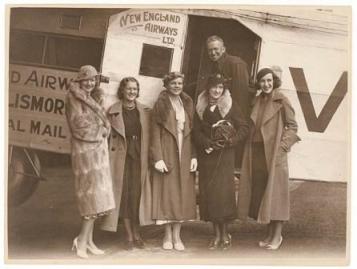
  • New England Airway Passengers. My favourite photo, hence it's inclusion in the post. look at the coats worn by the women. My favourite is the fur coat on the left. Presumably coats were necessary because of the cold at altitude. Note the hair styles.

Thursday, December 31, 2009

New England Story - Leslie Hubert Holden and the DH 61 Giant Moth Canberra

Holden DH61 Armidale John Caling kindly sent me this photo taken by Leslie Henderson, his mother's step-brother and a keen amateur photographer.

John wrote:

Hi Jim,

The above attachment is a scan of a pic of a de Havilland DH61 Giant Moth taken at Armidale. I am afraid I do not know where or when. My Mum told me that this was the first passenger aircraft to land in Armidale. I do know that QANTAS purchased two of these aircraft but withdrew them from service in 1935 because of unreliability problems. These two aircraft operated out of Longreach so the one in the pic is obviously not from QANTAS.

The picture made me curious. If you look at the clothes, you can see it's quite early. Men's hats remained relatively constant. However, the women's and especially the girls' hats suggest late twenties or early thirties. So I started doing some digging.

The plane in question - VH-UHW - was purchased by Leslie Hubert Holden in 1928.

L H Holden was very much in the tradition of the early fliers well summarised in the song:     

Those Magnificent Men In Their Flying Machines.
They Go Up, Tiddly, Up, Up.
They Go Down, Tiddly, Down, Down.

According to Carl Bridge's entry In the Australian Dictionary of Biography, Holden enlisted in the Australian Imperial Force in May 1915 and went to Egypt as a motor driver. In December 1916, now in France, he was one of the first batch of 200 volunteers to train in England for the Australian Flying Corps.

Carl suggests that Holden's mechanical sense and his calm but adventurous nature made him a natural pilot and he quickly won his wings as a lieutenant. Flying a D.H.5 in No.2 Squadron, A.F.C., he saw the first Australian air action of the war over St Quentin on 2 October 1917.

Throughout the battle of Cambrai in November he strafed the enemy front line from a height of fifty feet (15 m); three of his machines were 'written off' under him. In one encounter, the famous von Richthofen fired at him from below; the bullets ripped up through the floor and tore his leggings. Holden nursed the badly damaged plane home, losing a wing on landing. His ability to return alive in wrecked aeroplanes earned him the nicknames of 'the homing pigeon' and 'Lucky Les'.

After returning to Australia in June 1919, he became Sydney manager of Holden's Motor Body Builders, the Adelaide company formed by his uncle H. J. Holden, with his son (Sir) Edward W. Holden. However, bitten by aviation bug and with financial support from friends, he bought a D.H.61 biplane in 1928 which he named Canberra.

Flying the Canberra, Holden operated charter flights from Mascot, Sydney. In April 1929, he was engaged by the Sydney Citizens' Relief Committee to fly to north-western Australia in search of (Sir) Charles Kingsford Smith and Charles Ulm who had disappeared while flying to England. Holden found them on a mud-flat on the Glenelg River near the Kimberleys and returned a hero. However, when newspapers accused Kingsford Smith and Ulm of a publicity stunt, the Sydney committee refused to cover his expenses!

In 1926 gold was discovered at Wau in the then Australian mandated territory of New Guinea. A rush began. Attracted by the aviation opportunities, in September 1931 Holden and the Canberra made what was probably the first flight from Sydney to New Guinea to begin a successful air-freight business.  

Returning to the Armidale photo, if we look at the dates it must have been taken between 1928 and the September 1931 flight to New Guinea. My feeling is that the photo may actually have been taken on the flight to New Guinea.

In 1932, Holden returned to Sydney to purchase extra aircraft and to form Holden Air Transport.  Tragedy now intervened.

In September 1932 Holden joined a New England Airways plane in Sydney to fly to Brisbane. He was killed on Sunday 18 September 1932 when the New England Airways Puss Moth crashed near Byron Bay.

This was not quite the end of the story. In New Guinea, the locals raised 25,000 pounds to continue Holden Air Transport.

And what happened to the Canberra itself? On 2 November 1934, it hit a building in Rabaul and was destroyed by fire.

Notes:

This story is drawn especially from Carl Bridge's entry on L H Holden in the Australian Dictionary of Biography. The Australian National Library has a number of photos of the Canberra. A fascinating picture of aviation in New Guinea at the time can be found here. You can see a Holden Air Transport badge featuring the Canberra here. The De Haviland archives have details of the fate of all DH planes. For posts on New England aviation including New England Airways click here.      

Sunday, April 22, 2007

New England Australia - what brings people to this site

I have been reviewing visitor patterns to see what brings people to this site.

Of the last ten hits, one was a direct hit, one a referral from the New England History blog, eight came in through search engines.

The first search on Google Australia but whole web was on nsw election 2007. The story I did on the New England results came up on the first page and drew the visitor. The search also picked up two broader posts I did on Personal Reflections , so three of the top ten items picked up by Google were in fact written by me.

I write from a personal perspective, but I also try to give both links and data, so I hope that the visitor found the material of some use.

The next search, again on Google Australia and whole web, was on "G A Robinson" Lismore. I have mentioned Mr Robinson a number of times in the context of the foundation of New England Airways (list of posts here), so these posts came up in the first ten hits.

I had not done this exact search myself before, so picked up a few more references myself. One was a short factual note on oldbeacon, a second a passing reference in John Gunn's book on Amazon.

The third search on Google was buzo, alex. This picked up, again in the first ten references, the story I wrote about his death. I have noticed over time a steady interest in Alex. The story on him on Wikipedia is very short. I hope that someone with more literary knowledge than I have will extend it at some point.

There were two searches, different IPs, on Google Australia but whole web on Slim Dusty. Both picked up the story on the Slim Dusty Centre project in Kempsey.

Interestingly, the first search on slim dusty history brought the story in among the first ten. In the second on just slim dusty the story came in at number 43, so my visitor had to go through a few pages to find it.

History birpai tribe on Google Australia whole web brought this blog up in the first ten. I am sure that whoever was searching was disappointed because I have only one passing reference. I can do something about this.

A ninemsn search on the university of new england's centre for local government brought this blog up number one. A totally undeserved result brought about by the way the search engine robots combine words.

Finally, a Google search on towns in new england nsw captured the story I wrote on New England's poor towns at number 3.

This result made me a bit uncomfortable. That story was sparked by Professor Vinson's study of disadvantage and addressed a failure in public policy. I would not want the post to be seen as a total story of all New England towns.

I have written about a fair number of places. I wonder how I can make this more accessible?

A few late additions

I had just finished this post when a few new hits appeared.

Still on the weird and wonderful was the search on Google on number of children per Morman family 2007. I have one reference in one post to the Morman Church, the story on my year five class at the Armidale Demonstration School that somehow bringing the site up in the first ten.

Next came a search on ninemsn on stats youth crime in cessnock nsw australia. I think from the words on the search page that my post on the NSW State Plan was the trigger here, but when I followed the msnsearch link back it bought up a number of posts in a series, some form of consolidation brought about by the msn search robots.

Then there was the search on king family at bingara. Here my story on the death of David Armstrong who was born in Bingara and was known as the king came up as the second item. I hope that my visitor found the story of some interest, although it had nothing to do with the King family as such.

I am always interested in New England families, so followed some of the links myself.

The first click led me to Message Stick on the National Indigenous Times (19 April 07) focused on finding missing relatives. Nothing on the King family, but interesting.

Then a click took me to the Peerage.com, a genealogical survey of the peerage of Britain as well as the royal families of Europe. This is a somewhat eccentric but interesting site maintained by Daryyl Lundy in New Zealand.

Here I learned that D'hrie King, the daughter of Frank R King of Bingara, married Sir William Windsor Broun of Colstoun, 13th Bt. Here I found a list of people with some connection to the peerage grouped by NSW town or suburb. The list is not complete, the Crofts are not on it as a New England example, but it is still an interesting byway.

Another link led me to Joyce and Neville Bryant's home page.

While they now live in Stanthorpe just over the New England border in Queensland, Joyce was born in Glen Innes and then boraded in Armidale to complete her secondary education at the Armidale High School in the early 1950s. The site includes some interesting material on the Hartman family of Glen Innes.

Yet another link led me to Aussie Rhonda's Geneology site. This is a very good site with a strong focus on the western New England Tablelands and slopes. It includes a useful page of resources. Saddly, when I went to leave a message in the guest book I found that this section of the site had been closed because of, you guessed it, the impact of spammers.

Saturday, January 30, 2010

New England Motor Company - Lismore

Nemco buses

Over time, I have carried a fair number of posts dealing with New England Airways.

In those posts I picked up references to George A Robinson's motor transport interests. However, I had no idea until I finally read Joan Priest's Virtue in Flying, a biography of pioneer aviator Keith Virtue (Angus & Robertson, Sydney 1975) just how important those transport interests were.

This photo shows two of the buses belonging to Robinson's Lismore based New England Motor Company.

It's not a good reproduction, but it does give you a feel for the time.

NEMCO was a pretty big operation, big enough to provide not just financial support to the unsubsidised New England Airways, but also core technical and logistical support.

Both were critical. NEA was the only major unsubsidised airline, while it began at a time when you had to be able to maintain and sometimes rebuild your planes by yourself independent of outside support. Damage from hard landings had to be fixed, while the engines themselves could be very cranky.

Mechanical knowledge was therefore critical. Here NEMCO's need to maintain its own buses meant that it had the mechanical skills to support the airline and especially in the critical early days before NEA got big enough to establish its own service facilities.

According to scuba on the Bus AustraliaNEW ENGLAND MOTOR CO LISMORE NSW WHITE MO-7390 web site, the first bus in the top picture, the WA 20 White was built by NEMCO in their own garage. I wonder how many current Australian bus lines could actually build a bus?

The second colour photo shows another variant photographed in Kirklands Garage several years after their purchase of NEMCO.

Scuba also reports that the Ranger, the second bus in the top photo, was one of a pair built by Athol Hedges in Northgate (Brisbane). These were purchased for the Lismore - Tenterfield run, but were also used on the Lismore - Brisbane run in later years until the sale of the company in 1970.

The next photo is a more modern photo of one of the Rangers.

The roads these buses travelled along could be quite dreadful, clouds of dust when dry, clinging mud when wet.NEW ENGLAND MOTOR CO LISMORE NSW AEC RANGER MO-347

Now I have discovered just how important the New England Motor Company was, I am keen to learn more. 

Here I discovered from scuba that there is a history of NEMCO - Kevin R Kirkland, comp, Life’s a journey: the Kirkland and New England Motor Company story. Lismore, the author, 1999.

There are two copies in the Lismore Historical Society collection. A trip to Lismore? 

Tuesday, October 17, 2006

New England Australia Aviation Pioneers - the Virtues


Photo: Australian National Airways Captain Keith Virtue posing with DC-3 VH-ANR "Oana". Keith Virtue was the first Australian pilot to accumulate 20,000 hours.

Source Virtue family collection, from the Cuskelly site. This site includes a range of aviation related material, including the story of Adastra, another of Australia's pioneer aviation companies. The Sydney based Adastra was founded in 1931, finishing its life in the 1970's shortly after its acquisition by East West Airlines and the relocation of its HQ to Tamworth.

My thanks to Bruce Robinson and to John Lee from Chicago for more material on New England Airways and those associated with the company. I am still absorbing this. In the meantime, a brief snippet on another part of the pioneer story, Keith Virtue, who was a pilot with New England and went on to a long and distinguished career in Australian civil aviation.

Thanks to Bruce and John I now know that there is a biography of Keith that also covers the early days on New England Airways and of Airlines of Australia, Joan Priest's Virtue in Flying. (Angus and Roberston, 1975). So I have put this on my list to find, read and report back.

As I presently understand it, Keith was the youngest of ten boys and grew up near Lismore. An elder brother Ralph was also a pilot with New England and was killed in the NEA plane crash that also saw the death of pioneer aviator Leslie Holden plus another. I understand that there is a memorial near the crash site.

Again as I understand it, Keith married one of G A Robinson's daughters. By the end of his flying career Keith had established what was probably a world record of around 40,000 commercial flying hours, a title later taken over by his nephew Jason Hassard, 42,000 hours. I think that Jason was also a pilot with Airlines of Australia.

I will write more later. In the meantime, checking material reminded me that one of Australia's most famous air crashes involved an Airline of Australia Stinson flying btween Brisbane and Sydney in 1937. The plane crashed on the Lamington Ranges shortly after take-off from Brisbane. A search failed to find the wreckage.

Nine days after the crash, Beaudesert grazier Bernard O'Reilly set out on foot to find the plane. Through his superior bush skills he found the crash site and, to his surprise, two survivors in desperate need of medical attention. After making them comfortable, he left them to organise a rescue party. The full story can be found in the Queensland Government archives.

Thursday, January 04, 2007

Transport Pioneers - The Robinson Family: a further note


Photo: Passenger vehicle used by Robinson Bros Motor Service, Kempsey.

As I dig into New England's past, I find it interesting that the influence of certain families keeps on recurring in particular sectors.

In earlier posts I spoke of the Robinsons and Virtues in the context of New England Airways and the development of civil aviation in New England and beyond (see stocktake on transport posts). Now reading Marie Neil's Valley of the Macleay (Wentworth Book, Sydney 1972 pp-79-80) I found out that the Robinson family's connection with New England actually began in the Macleay Valley.

Around 1859 George Robinson came to the Macleay Valley, soon after selecting land at Jerseyville in the Macleay delta downstream from Kempsey. He and his brother John ran a river boat service for some years (river transport was critical to Valley transport and communication) until the partnership was dissolved and George became a storekeeper at Jerseyville.

No less than four of George's sons were to become well-known in the early days of motor transport on the North Coast.

George A Robinson who was to go on to found New England Airways began conveying passengers in a sulky or buggy. In 1910 he began a charter service using a two cylinder Talbot car (and here) followed by a four cylinder Clement Bayard (here, in French I'm afraid) used to provide a twice weekly passenger service to Taree.

In 1911 George A acquired a vehicle capable of carrying ten to twelve passengers on the run and was joined in the venture by brother William T Robinson. George A was to move to Lismore and leave the partnership, although I am not sure of the exact chronology of events since Robinson Bros also (I think) operated out of Lismore.

William carried the business on, adding more vehicles and extending runs to Newcastle and Grafton before he too left the district, moving to Grafton where he later became mayor.

In addition to George and William, Walter and Albert Robinson also became involved in land transport, running early mail and passenger services between Kempsey and South West Rocks.

These early days of motor transport could be strenuous and adventurous. The often heavily laden cars travelled over unformed dirt roads that were often rough, dusty when dry, boggy when wet.

Wednesday, December 06, 2006

Big Sky Express & New England's Aviation Woes

In previous posts I began to sketch out the history of aviation in New England starting with New England Airways.

Over the last fifty years New England has seen the rise and fall of a number of local airlines. East West Airlines, Eastern, Oxley, Tamair all rose either to be taken over or forced to close for trading reasons. Other airlines such as Impulse, Hazelton and Rex have entered the market, made a special feature of New England and then been forced to withdraw in whole and part.

We can now add Big Sky Express and Sunshine Express to the growing list.

I was sorry to see that Big Sky Express had struck problems. Big Sky was unusual as a community based airline. Following the loss of air services to Gunnedah and Inverell back in the 1990s, , these communities including Shire Councils and businesses combined along with private investors to create Big Sky Express as a community airline. Services began with flights from Inverell and Gunnedah to Sydney, with Grafton and Taree services added later.

The Brisbane based Transair provided aircraft and operational support the new community airline. This model - a community or locally owned business backed up by a service provider - has become very common in Regional Australia as a way of filling gaps left by the withdrawal of big metro based businesses from parts of the country. The Bendigo Bank is perhaps the best known example.

The model depends for its success upon the strength of the service provider. Unfortunately for Big Sky, TransAir had been experiencing problems for some time including a major accident that killed 15, was grounded in November over safety concerns, and has now closed entirely with possible criminal charges pending. Big Sky has closed as a consequence.

We can also add Sunshine Express to the list. Sunshine withdrew from all scheduled services in September.

The Armidale Express reported the airline's departure with the last Armidale-Brisbane flight - one way only - on September 30.

According to Sunshine's Laffer, "The reason behind our decision to withdraw airline services is that in two of our key markets in Queensland, Hervey Bay and Biloela, QantasLink has announced that they are entering those markets," Mr Laffer said.

"As a result of that we have no alternative other than to withdraw our services from other markets to maintain a viable business".

Prior to its withdrawal, Sunshine Express was able to secure interest for the Port Macquarie-Coffs Harbour-Brisbane air service with the Canberra-based Brindabella Airlines taking over the route plus one aircraft and a number of staff. However, this left Armidale and Tamworth without a Brisbane air service.

Sunshine's withdrawal came just two months after REX Airlines withdrew from the Armidale-Sydney service, leaving Armidale with with only the Sydney-Armidale service provided by QantasLink.

The last time Armidale was in this position air traffic declined very sharply because of the high fares set by QantasLink. REX's entry to the market with consequent fare reductions saw a significant increase in air travel.

Wednesday, January 28, 2009

Belshaw’s World: why are we crushing our schools?

We presently live in a measurement obsessed world, a world of inputs, outputs and outcomes, of key performance indicators. This is a world of league tables, of standardization and uniformity, of professionalisation and accreditation.

We live in a world obsessed with risk avoidance with its associated concepts of informed consent, duty of care and risk management or mitigation strategies.

I was a strong supporter of the education reforms that began in 1988 spear-headed by Commonwealth Education Minister Dawkins because I saw them as a way of freeing up the education and training sector.

I still support many of the concepts. However, I now think that the practical effects have become quite pernicious.

Over the last few years of my daughters’ schooling, I watched what I saw as the erosion of the ethos of their school with sadness and a degree of anger.

This process stands out in my mind as a series of events.

The circulars from the school telling us of new Government requirements increased. We were required to provide new information and sign new forms.

The range of activities open to our daughters began to contract because of perceived risk. We went to our first information session on a forthcoming excursion.

A confused parent said to me “well, that was a waste of time. We know all that. Why are we here?”

“It’s got nothing to do with us”, I replied. “It’s for the school’s legal protection, so that they can say that we have given informed consent.”

Teachers began to complain privately about the new loads placed upon them. The school suddenly demanded that parents sign in at the office before going onto school grounds.

Those of us at the school all of the time for meetings or to attend sporting events simply ignored this. However, I noticed that new parents were beginning to comply.

New security cameras were introduced, followed by guards. Then came a new central security system with various alarms and self locking doors. Lock down and lock out had arrived.

This was being done, the school explained in a circular, “for the protection of your daughters.” You could be forgiven for thinking that the school had a significant security problem. It did not.

Fees continued to rise faster than inflation to pay for the new administrative staff required to meet increasing Government reporting requirements, as well as all the new security arrangements.

On legal grounds, the school decided that it could no longer coordinate the preparation of the traditional year 12 annual. The students would have to do this for themselves.

At eldest’s year 12 formal in 2005, students were banded with hospital style bands that allowed those over 18 to buy single drinks. Parents were allowed to have wine on their tables.

Two years later youngest’s year 12 formal was held at a posh Sydney hotel.

The event had to be completely dry for all. There were the usual pre-formal parties. However, upon arrival at the hotel, the kids were not just bag searched but also breathalysed. Any recording a positive reading were not allowed to enter.

Parents went ballistic. The security guards explained that they had no choice; they must comply with new NSW Government legislation.

By nine o’clock most parents had adjourned to the bar. By 11.30, half an hour before the official close, the ball room was empty as kids moved off to the after-formal parties.

Last year to the fury of my daughters and their friends, the school abolished muck-up day. This had been a pretty mild affair run under tight controls. Even this was now seen as too dangerous.

I could, perhaps, live with all this if the standard of education had improved. It declined, crushed by the growing burden of compliance and risk avoidance.

To answer my last question.

New England’s first major airline was, appropriately, called New England Airways.

Formed by George A Robinson, the Lismore headquartered company began a bi-weekly Lismore-Brisbane service in August 1931. This was later extended to a Lismore-Sydney service, creating the first Brisbane- Sydney service. The company grew to be one of the first national carriers.

Now for my next question. What is the connection between Dorrigo, cattle ranching in Wyoming and the imperial courts of Europe?

Note to readers

This column appeared in the Armidale Express on Wednesday 21 January 2009. This post brings my columns up to date with exception of the column appearing in today's Express.

In future I will publish them on a Wednesday, thus lagging them by one week after publication.

Friday, January 08, 2010

New England's aviation pioneers

Kind of side-tracked this morning writing Stories from the barnstorming days of Australian aviation. I wonder how many North Coast people know that pioneer aviators used to barnstorm along the coast, that the early aviation industry landed on beaches, open paddocks and sometimes roads?

I have written a number of posts on this blog about the history of aviation in New England, including New England Airways and East West Airlines. Time to update and consolidate the story, I think. But this will take a little while!

Friday, August 14, 2009

Armidale Air Show 1959

1959_Southern_Cross_3

Back in September 2006 in New England Australia - Aviation I spoke of Australian aviator P G Taylor.

Now in The Southern Cross comes to Armidale Paul Barrett has returned to the theme.

I won't repeat Paul's story, you should read it yourself, but I could not resist one of his photos.

This photo shows the Southern Cross, Kingsford Smith's plane, at the Armidale Airshow in (I think) 1959.

Dear this took me back. Hats are still in, while women's dresses are still in shapeless mode! I really love old photos because of the way the detail tell's us things. To see what I mean have a look at New England Airways - Postscript.

1959_Southern_Cross_2 Took me back. I actually have this vague memory of queuing to see the plane.

I said that I could not resist one of Paul's photos. Well, here's a second!

This one gives you a better view of the queue formed to see the plane. If you click on the photo you can see the school girls queued at the front.

Things like this were big time. Indeed, they still are.

One day I will write a little about air shows I have seen!