Tuesday, November 01, 2011

Belshaw's World - life, death and Sydney’s real estate prices

Another column, another blank screen.

I spent yesterday morning shifting book boxes from one storage shed to another. As I write, my back is killing me, a salutary reminder that I may not be as young as I once was!

I saw from the paper that Lloyd and June Piddington have celebrated their 65th wedding anniversary. Sixty five years! That’s a very long time indeed. My congratulations.

By the nature of their business, the Piddingtons have been entwined with Armidale life for a very long time. In my own case, they have buried grandparents, parents, aunts and uncles.

A family death is always stressful. The thing that I most remember is the calm kindness with which Lloyd and other family members handled the inevitable problems.

Down here in Sydney, the news that the NSW economy is in the slow lane nationally has attracted some attention. The problem from my perspective is that there is no such thing as a NSW economy.

To the good folk in the NSW Treasury the concept makes some sense because they have to estimate tax revenues. For the rest of us, NSW is increasingly little more than lines on a map providing a notional unity to an increasingly disparate territory.

Because of its size, Sydney dominates the numbers. Even in Sydney, there are considerable variations across the city. As we move outside, the variance becomes greater.

Take real estate.

In Sydney, house values have held up, but sales are down. The value of transactions is down nine per cent compared to the five year average.

In the sea change regions of the Northern Rivers and parts of the Mid North Coast, the value of transactions is down 30 per cent on the same basis. By contrast, the mining areas of the Hunter or areas around the ACT are trending above average.

Three areas with three very different performances.

In Sydney, real estate continues to dominate many dinner party conversations. The prospect of quick profit stays in mind, as it has done since the first days of European settlement. However, with Sydney real estate flat, home purchases in the US have become the new investment topic.

There are good practical reasons for this. Both countries have stuffed up their real estate markets.

In the US, rules that limit bank recovery to just the value of the property in conjunction with losses associated with the end of the property bubble have made banks unwilling to lend, while people are also reluctant to invest. House prices have fallen much more than rents, making for very good rental yields.

In NSW, by contrast, it is expensive to develop land or to build houses. Residential building has been low for some time. This leads to high prices and low rental yields; the prospect of capital appreciation dominates expected returns.

With capital appreciation uncertain, people are unwilling to buy even though Australian banks will lend. With the stock market also uncertain and interest yields quite low, some are now investing in US real estate to take advantage of the high rental yields.

With gain comes the risk of pain. Some will be hurt. However, there is a more immediate problem from my perspective.

We rent in Sydney, part of an increasing group forced to do so because of the very high real estate prices. This is a bit of a nightmare, one that is rapidly becoming worse. There simply aren’t a lot of long term lets of the type we want.

We have moved four times over the last five years, with another move possible next May. Each time rents have increased.

Listening to people chat about US housing investment, I just think of what it means for local rents. I also think about my back!

Like other Sydney costs, storage costs have been rising. We are therefore trying to reduce material in store to fit into a smaller and cheaper storage area.

This is complicated by the fact that last time we moved, we moved into a smaller house. This meant more stuff to store.

This morning I have the last twenty boxes to check and move. Oh my aching back!

Note to readers: This post appeared as a column in the Armidale Express on 26 October 2011. I am repeating the columns here with a lag because the Express columns are not on line. You can see all the columns by clicking here for 2009, here for 2010, here for 2011.

Sunday, October 30, 2011

Grafton to Inverell cycling classic turns 51

One of Australia's oldest road races is the Grafton to Inverell Cycling Classic has just turned 51. Clarence Valley Today was there to record the start.  

This is a pretty but rugged race that crawls up the escarpment from Grafton, runs across the New England Tablelands and then down to Inverell. Mark's posts are:

Friday, October 28, 2011

Why Newcastle's Urban Insider is just so good

Yesterday's post, Why new state New England must have its own tourism strategy, dealt with the need for us to have a tourism approach independent of that applied in NSW.

Tourism is all about experiences. An experience is not just a good meal or a cup of coffee on its own, but those things in a context. You can get a good meal or a cup of coffee anywhere. Generally you remember them because something else is added in.

One of the things that I have tried to do in my writing is to draw out a little of the richness of New England life and history. Here I am trying to add a context, something that will make both New Englanders and visitors aware of our special features.

I have often spoken of the unrecognised features of Newcastle, the things that add specific richness to that city, a richness that can be enjoyed by locals and visitors alike. Sadly, things that are unrecognised die or are demolished. It is only later that we become aware of what we have lost.

From time to time, I have referred to Newcastle's Urban Insider. This relatively new e-magazine focuses on the texture of Newcastle life. It's great.

Just consider this feature by Matthew Endacott, Curtain Up Newcastle! The Theatre Town That Was. I have written a little on Newcastle's theatre tradition trying to understand something of its history. Matthew's article extends my knowledge.

The point about Newcastle's theatre tradition lies not in the comparison with other places, but in the fact that it is Newcastle's tradition. It is special to Newcastle.

To my mind, the brilliant thing about Urban Insider lies not in its immediate benefit to those living in Newcastle, although that's substantial. Rather, it is part of a process that is accumulating the Newcastle experience and making it available to a world well beyond Newcastle. 

Thursday, October 27, 2011

Why new state New England must have its own tourism strategy

This post began as a Wednesday Forum discussion, but was then delayed until today by other pressures. This then allowed me to read David Whitley's piece Sorry Australia, Europe rules. He compares Australia adversely to Europe, suggesting that things like the Opera House cannot compete.

I agree with him. Indeed, I have written about the new love affair that many Australians have with Europe. I have written about the trails that our young follow through Asia. Australia as a new country cannot match the history and accumulated experiences, the very exotica, When the Sydney glitterati want to promote the city's museums, its cafes, they are no different from a country mayor who wants to promote a local park. The park may be nice, but it is not a draw in its own right. Both are blinded by the wrong comparison. 

I also agree with his conclusion: 

These things (the European attractions) are always going to appeal. There's nothing Australia's tourism authorities can do about them – but they can differentiate and sing about what Australia does do better instead.

If the broader new state New England is to attract increased visitor traffic, it has to focus on its unique features, those things that are distinct. Those things are not the same as Sydney.

The history, the geography, the style are all different. So long as New England is merged with, subordinated to, tourism promotion based on Sydney then we will fail. And so will Sydney.

We can see this is the failure of NSW tourism promotion and the two brand strategy - brand Sydney on one side, brand NSW on the other - over a very long period.

The NSW Government's attempts to promote Sydney as a global city, as a cosmopolitan global centre, fail in international terms because it puts Sydney in competition with a London or New York, a Singapore or Shanghai, and Sydney fails this test. In domestic terms, the Melbourne or Adelaide promotion of life style attracts domestic visitors, Crudely, Sydney is reduced to a bridge, an opera house and a harbour.

Elsewhere in NSW the position gets worse because NSW has no identity. If you look at international tourism promotion, Sydney itself gets a guernsey, but the rest of the state might as well not exist. If you look at domestic promotion, NSW is the only state without any form of definable tourism identity. Yes, that's right, the only one.

Try this test.

Ask people that you meet what are the key tourism features of each state, the few words that describe it from a visitor perspective. I bet you, the only words you get for NSW will be a few Sydney based attractions. All the other states will attract words linked to experiences.

New England suffers particularly because its identity is not recognised. We do have our own history, we have our complex life styles, we have great variety and attractions. Each is served up in fragments in the ill-defined stew that is NSW.

Many of us had hoped that the new NSW Government would address some of our concerns. At least so far as tourism is concerned, we now have enough evidence to suggest that it will follow the same path as before. I stand to be corrected, but I know of nothing in current plans that will aid us.

As before, the tourism strategies are fragmented and effectively deny our identity. Our history and special features are simply ignored.

Is is possible to have a unique New England brand? Certainly it is. This would centre on the North, the emergence of New England, our 150 year fight for statehood. It doesn't matter whether you agree with self-government or not, it's a unifying story.

New England tourism promotion would start with a central identity, but then focus on the promotion of difference, putting this in a broader New England context. Newcastle, for example, would emerge from the NSW imposed shadows as a distinct centre in its own right. The different New England wine regions would be promoted as an entity and in their differences.

How can you promote NSW wine when there is no unity, when people must choose one area but not another? In Victoria and in New England it is possible to do an integrated wine tour.

In Victoria, Geelong has established itself as the national wool centre from a museum perspective. Yes, the Western Districts are important, but so is wool in New England. Yet who would know?

I could go on, but will pause here with a plain statement.

If the NSW Government really wants to help New England tourism, then it must focus on the promotion of New England as an entity. This implies largely doing away with brand NSW and instead focusing on the promotion of the broader geographic entities making up NSW. If it can't do this, then let us go our own way.

Postscript

A brief response to some of the issues raised with me on this post.

First, by new state New England I mean the Tablelands, the coast, the Hunter, the Western Slopes and Plains, not just the Tablelands.

Next.

Surely David Whitley's comment on Australia as a whole applies to New England? What makes you think that a New England brand could attract international visitors in its own right?

That's absolutely right. In the medium term, say ten years, a New England brand would be unlikely to attract significant international traffic in its own right. What it would do is to increase our share of visitors already coming plus make a small incremental contribution to the totality of Australia's international tourism promotion.

We have to keep a sense of perspective. A Rhodes or a Santorini already attracts more international visitors in their own right than the totality of New England's international visitors because of history, romance and closeness to Europe. We are talking about a slow build process.

What's New England got that would attract visitors compared to other parts of Australia? They have beaches, national parks, festivals etc. They have far better developed tourist attractions. Why should people bother going?

Sigh. I actually get this type of comment from Sydney dwellers quite a bit. Many of those living in Melbourne, for example, don't even know where the place is. Yet we have some of the best attractions and locations in Australia.

Alright, what would a New England tourism strategy look like? Why would it work?

In considering this we need to take two things into account:

  1. Visitors are attracted by a total experience. That takes time to build.
  2. Low visitor numbers to many parts means that New England tourism economics are severely constrained. We presently don't have the spend to support basic infrastructure or visitor related activities. Again, this takes time to address.

In terms of markets, a New England tourism strategy would:

  1. Promote New England to locals to encourage greater internal traffic. Do you know, there are Newcastle people who have never visited Armidale, Armidale people who have never visited Newcastle? There are new arrivals in some coastal centres that have never been over the ranges. And so it goes on. Towns don't sell to each other, they sell against each other. Glen Innes could probably double its total Celtic festival visitors from Armidale alone. How many Armidale people know about Inverell's Pioneer Village? Or have been to Timbertown? Internal promotion - taking in each other's washing if you like - can help improve economics and add to the human experience for locals and visitors alike.
  2. Adopt a highly segmented approach taking geography and travel time into account. For example, Tenterfield would promote itself in its own right - Henry Parkes, Tenterfield Saddler, etc. It would be promoted as an extension of the Granite Belt to attract add-on visitors especially from Brisbane, but also be promoted as part of the New England geographic wine region. Tenterfield should cross-sell, encouraging its visitors to go to Stanthorpe and the Granite Belt for wine, to drop down to the Richmond and Tweed valleys, mentioning Armidale in the context of Peter Allen.
  3. Adopt a thematic, niche, special interest approach linking different parts of New England. Wine, railways, mining, whatever you like. Anything that appeals that would also get people to travel more broadly within New England once they are there.
  4. With all this unified within a central New England brand. 

The coordinating promotional role would involve, among other things:

  1. Promotion of the central brand.
  2. Coordinated campaigns based around key themes.
  3. The use of tourism facilitators whose role would centre in part on encouragement of cooperation at local and  regional levels within the broader New England.

A key feature of the central role would be a focus on and promotion of difference, of features unique to specific localities or areas. Parochialism is deeply entrenched within New England. It should be used as an asset, not liability.

Postscript 2

Greg Commented:

Jim, I read this article yesterday and what struck me was the Sydney/Melbourne centric viewpoint. There is so much more to Australia than just two cities. Let's face it, if you are from the northern hemisphere and you want the experience of a cosmopolitan world city, then travelling half way around the world to Sydney is not going to be high on your list.

There was also the disparaging comments about our smaller cities eg. Newcastle, Wollongong, Ballarat and Bendigo, being vastly inferior to the many European small cities eg. Oxford, Cambridge and Bath. The logic seems to imply that because our smaller towns and cities lack 1000 years of history and mediaeval architecture that they are simply not worth visiting. What an appallingly narrow minded comment.

What we do have is an entire continent out there with a multitude of different destinations, all with their own unique landscapes and stories.

We can never compete with Europe if your interest is castles and cobbled streets, but that is not necessarily everyone's ideal holiday experience. Our own tourism authority could market and leverage off our own unique strengths. Our climate, unique landscapes, laid back lifstyles and our own story - something that you simply cannot experience anywhere else.'ll mention Newcastle, because it is obviously what I know best. Where else on earth can you experience world class beaches, a large coastal lake, the bays, sand dunes and blue water of Port Stephens, world class wine districts, ancient rainforests and a climate ranging from subtropical to alpine in the highlands of the Barringtons - all between 2 minutes and 2 hours of the city CBD? You would think that would be a tourist marketers dream. Yet if you relied on NSW Tourism website you might never know most of it existed.

Postscript 3

The Sydney Morning Herald (29 October) carried an interesting piece by Sean Nicholls Cashed up, curious - now to get them on the plane on the plans of Destination NSW. If you read the piece, you will see the same use of ambitious targets (double the money spent by tourists in NSW in 2020); the same focus on  what are perceived as golden markets, in this case China and to a lesser extent India; the same ambivalence and confusion between Sydney and NSW; the same focus on big ticket events; and an apparent disconnect between target and activities.

In fairness, Destination NSW is presently developing a strategic plan to achieve its objectives. Perhaps we should wait and see. However, having watched multiple planning processes over decades, I don't feel confident.

Tuesday, October 25, 2011

Belshaw's World - Summer days, Blue Hole and the 'Terrible Quads'

Note to readers: This post appeared as a column in the Armidale Express on 19 October 2011. I am repeating the columns here with a lag because the Express columns are not on line. You can see all the columns by clicking here for 2009, here for 2010, here for 2011.

Cousin Jamie has been posting family photos. I, too, have been going back through some of my own collection looking for shots that might be worth putting online, as has brother David.

Between us all, there are hundreds of photos not counting the proliferation that came with the digital camera. Eldest’s face book page actually has more photos than the entire collection!

Family photos can be an issue, for what is interesting to the family can be dead boring to the outsider. Older readers will remember the once popular slide shows – this is us in front of <insert appropriate monument>. Eyes glaze and bums get sore.

Still, when I look at our photos I suspect that some might be interesting if put into a broader context. They do cover more than one hundred years of New England history.

I don’t want to devote entire columns to family snaps. However, I thought that it might be worthwhile from time to time to use some photos as an entry point to discussion of aspects of our shared past.

A week or so back, there was a letter complaining about the condition of the road to the Blue Hole. I had to laugh, for the Blue Hole road has been the subject of complaint for a very long time!

Terrible Quads 1937 Blue Hole The Blue Hole has been a popular picnic spot for many years.. This photo is simply entitled "On a rock - the Blue Hole 1937, The Terrible Quads".

One person in the photo is Aunt Kay, but I have no idea who the other members of “The Terrible Quads” were! I suspect there are people in Armidale who might answer that question.

The thing about the Blue Hole is that it provided a deep swimming spot when they were relatively rare. This made it a popular swimming and picnic spot.

Other places such as the Pine Forest or the Gwydir did have deep pools.

I still remember skinny dipping at the Pine Forest getting a very burned backside as a consequence, but those pools tended to disappear as creeks silted up or changed course. The Blue Hole was different, always deep.

I first went to the Blue Hole as a kid many years after this photo was taken. The road was dreadful, really ruts wending their way across the paddock.

There were two things required to make the visit special.

One was a rope tied to a tree branch from which we could swing out into the water. The second were tire tubes.

In an earlier column I wrote about the experiences of my daughters tubing on the Mekong.

Our tubes were smaller, nor was the locale as exotic. Still, the concept was the same.

You could lie in the tube and look out at the world. More precisely, you could do so until someone tipped you out!

The problem with the smaller tires was the valve. I kept getting skin abrasions from those valves!

One feature of the Blue Hole was just how cold and dark the water became as you dropped below the surface. We used to dive down, but I never went very far because I didn’t like the cold. I still don’t.

This may sound strange coming from someone who grew up in Armidale, and indeed for periods I used to go swimming at the baths when they opened at 6am for training. Today that seems like insanity!

Thinking about the Blue Hole, I wonder if today’s Armidale kids have the same reactions that we did.

I know that when my girls were young we simply didn’t do some of the things that I had done. There were just so many more choices in terms of activities.

Monday, October 24, 2011

Just a bit more on the Werris Creek Railway Museum

So far I have written stories mentioning the Werris Creek Railway Museum:

Now Kelly Fuller from ABC New England North West has interviewed Chris Holley, President of the Museum. It's worth listening to for those interested in the Museum or railways more generally.

Thursday, October 20, 2011

Armidale High Class of 61 reunion

Back In June I went to the Armidale Demonstration School 150th anniversary celebrations and had a wonderful time washed in the warmth of nostalgia. Just as well there was some warmth. It was bloody cold! Just for consolidation purposes I have listed the various posts I wrote on the celebrations at the end of this post.

While there, I attended a planning meeting for the reunion of the Armidale High School Leaving Certificate Class of 1961. While I went to TAS (The Armidale School) instead of High, I was in the same class at primary school as the High group and remained friends despite the different schools. Now through the wonders of the internet, many of us are again in contact.

Armidale Express editor Christian Knight has kindly sent me some photos of the reunion for circulation among the Armidale Connection group. I will do so, but thought that I would run one group shot here. Names follow the photo.  

 ahs reunion group

From left back in the photo" Rex Jones, Ann Woods (nee Heagney), Lawrie Placing, Pat Schofield (nee Hume), Paul Sommerville, Phil Emery, John Bain, Darryl Clarke, Ray Christie.

From left front in the photo: Val Bevege (nee Edmonds), Maggie Fathers (nee White), Helen Jones (nee Davidson), Laurel Clark, Narelle Woodland (nee Todd), John Parsons, Jock Roxborough, Susan Chapman (nee McSpedden) and Bruce Whan.

Dear some of the names took me back! I wondered if Maggie Fathers (nee White) was the same as Margaret White who was in my year at Armidale Dem. To this day I still carry the nickname Chalkie among some because of our primary school friendship!

Just a reminder on a point I have made before. If you are having a reunion, let me know and I will publicise it here.

The Armidale Dem 150 Year Celebration Posts

Wednesday, October 19, 2011

Gordon Smith's Uralla

I am not running a Wednesday Forum this week because of time pressures. I am shifting storage sheds.

Instead, I thought that I would indulge myself with another of Gordon Smith's photos from his photo blog lookANDsee.

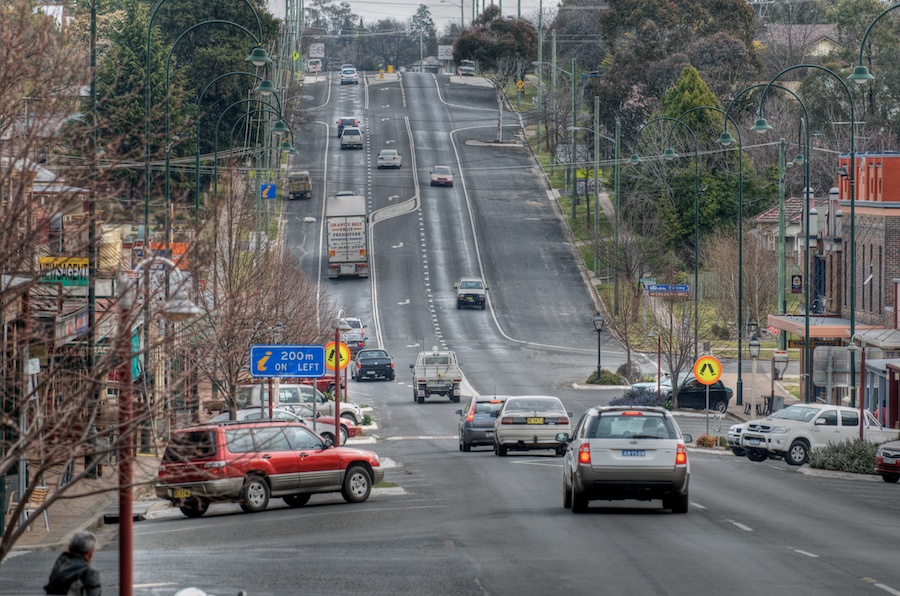
For those who don't know Uralla it is a small town (population around 2,300) 14 miles south of Armidale. This photo shows Bridge Street, the main street. Further comments follow the photo.

I am glad that Gordon is running a series of photos on Uralla. It's an interesting town well worth a visit. As so often happens, I suspect that Gordon's photos will give me lots of fodder for stories!

Tuesday, October 18, 2011

Belshaw's World - caught between a tweet and a print place

Note to readers: This post appeared as a column in the Armidale Express on 12 October 2011. I am repeating the columns here with a lag because the Express columns are not on line. You can see all the columns by clicking here for 2009, here for 2010, here for 2011.

From time to time I argue with Express editor Christian Knight about the need to bring the paper properly into the online world.

Now some Express readers might argue that immortalisation of the paper within the internet would be just too much of a good thing. Those same readers say that there is never anything in the Express anyway! Why, then, bother?

Editor Knight takes a different view.

As editor, he is hardly going to accept an argument that says there is nothing in his newspaper! His worry has been that if he puts the paper fully online, his Armidale readers may stop buying it and just read the online edition. This worry is set against the background of the general troubles facing the main Fairfax papers.

I don’t agree with those who say that there is no content in the paper, although I would accept that some editions do get a little thin. Living in Sydney as I now do, I read the Express quite carefully and find some very interesting content indeed.

A year or so back, one of my metropolitan blogging colleagues actually visited a country town, brought back a copy of the local paper, and then ran a piece parodying the stories.

Talk about come in spinner. I retaliated by taking stories from one edition of the Express and then comparing it with similar stories from Granny Herald. The Express stood up pretty well.

This type of disparaging attitude towards the country press in general is not uncommon.

In September, Express writer Janene Carey wrote on her blog about lunch with a friend who seemed bemused that Janene would want a part-time postdoctoral fellowship so that she could continue working at the Express. The friend asked Janene if she’d 'ever considered journalism as a profession?' - by which she meant a job on a "real" newspaper, a daily in the city covering serious, important stories.

Musing over this conversation, Janene simply recorded three stories that she had worked on that day, each local but with national or state implications.

The days when the Express ran front page foreign policy stories about developments in Tsarist Russia may be long gone. However, this does not mean that locally attuned reporting either lacks complexity or is without value.

I suspect that I probably read the paper from a somewhat different perspective to most readers.

It’s not just that I want to keep in touch with local developments. I also use the Express as a source of stories and ideas in a way that may surprise many.

I think that Armidale people have a tendency to knock the place. You might be surprised at the size of the Armidale footprint, at the way in which the apparently local actually has broader significance. That was Janene’s point.

Linking this now to my argument about the Express’s online presence, the paper actually serves two quite different audiences; one is purely local, the second is the broader and especially expatriate community with interests in Armidale.

If you limit the paper’s on-line presence to a small number of stories, then you are to my mind effectively penalising the broader Armidale community. I think that’s actually a problem for the city.

But can you broaden the online presence without affecting the local readership? I think that you can because the interests are different. You have, in effect, two linked publications.

I don’t think that I am going to win this argument any time soon, if only because of the way that Fairfax inline has been evolving.

In the meantime, I will continue to enjoy and use the print edition as a source of stories and ideas for a broader public.

Monday, October 17, 2011

Rod's Northern Rivers geology blog

I sometimes feel blessed with our fellow bloggers.

A few weeks ago I was driving eldest to work and said that I was trying to learn something about geology. She laughed and rolled her eyes! Geology is not one of her pet interests.

My problem is that I need to learn something about geology to explain elements of New England's life and history. As always by New England I mean the broader New England, not just the Tablelands. So I have been struggling away trying to come to grips with terms, trying to sketch a geological history. Now I have received a message from Rod wondering whether I would be interested in his new blog on the geology of the Northern Rivers.

Interested? I could kiss him on both cheeks! Further, it's not just me that is likely to be interested. I immediately thought of two of my favourite picture bloggers, Gordon on the Tablelands, Mark on the Clarence Valley. Both add background to their photos.

If Rod keeps going, I suspect that he will become a real resource for the rest of us. Rod's blog is Northern Rivers (NSW) Geology. Hey, I will even forgive him for adding NSW in the title!

Rod will probably need to do a bit of educating for the rest of us. Things like simple blind freddy overviews. 

Please visit. In the meantime, I have added the blog to my must read list.