Thursday, September 14, 2006

New England Australia Aviation - Don Shand


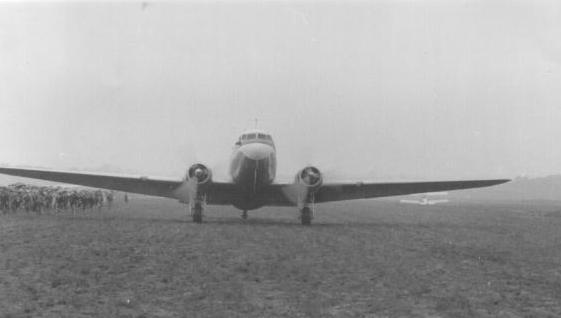
Photo: East West Airlines' DC3 lands at Port Macquarie

I really wanted to find a photo of Don Shand to illustrate this story. I could not.

Born in Sydney in 1904, Don Shand founded East West Airlines in 1947. The company had meant to fly east west between Moree and Grafton, but low traffic densities shifted the focus to north south between New England centres and Sydney.

Don was a remarkable man who deserves many posts. I thought that I would share some personal stories.

While I had heard many stories about Don, I first remember really remember him on a DC3 flight from Sydney to Armidale.

We had just come back from Bangkok. I knew something special was happening as we joined the plane because the crew were running round, holding us at the door. They removed a seat, allowing this very large man to occupy a full row. When I asked my mother who this was, she said Don Shand.

She told me the story of the time she was sick in Armidale Hospital. Her room overlooked the nearby park. She saw great activity with men stringing telephone wire towards the hospital. She asked the nurse what was happening. The nurse explained that Don was in hospital following a mild heart attack. Unable to get access to a phone for his international calls, there was no connection in his ward, Don had immediately ordered men in to install a new phone line to the hospital.

This from Uncle Ron.

Don had just married for the second time and had taken to wearing just a pajama top to bed. A fox had been attacking the hens, Don wanted to get it, so stood a loaded shot gun by the bed.

That night there was great commotion from the chook yard. Don jumped out of bed, grabbed the gun and rushed out the front door, calling his dog as he did so.

It was a bright moonlit night. Don saw the fox, propped, raised the gun to his shoulder. As he did so his dog, running behind and unable to stop, rammed his wet nose up Don's bare backside, causing Don to fire both barrels. The fox escaped, but there was awful damage done to the chooks!

Tuesday, September 12, 2006

New England Airways - Postscript


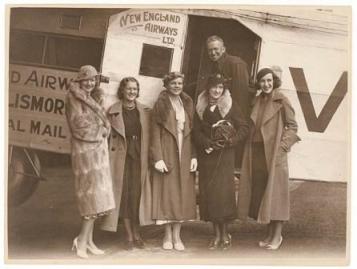
Photo: Passengers New England Airways Hood Collection

Since I wrote my first post on New England Australia - Aviation, I have found some rather wonderful pictures on New England Airways.

I cannot reproduce them all here. The e-blogger format will not allow me to do so in proper size, while I am also not sure of copyright issues. So what I thought I might do is insert one photo as a sample and then give you the links to them all with some comments so that you can enjoy them when you have time.

The photographs are:
  • The City of Grafton at night. The catalogue for this and the following shot refers to the City of Grafton as a WEA plane. I have done a web search check and there is a clear typo. It should be NEA. There is a gritty, almost war like, feel about this photo. Look at the uniforms.
  • Group with City of Grafton at night. Again a gritty feel. Note the different hats, caps and the young boy in the front.
  • New England Airways Lismore-Brisbane. A businessman gets off the plane. The plane's construction including the external control cables can be clearly seen. Note the Royal Mail sign. Mail contracts were a major driver in the formation of the early airlines.
  • New England Airway Passengers. My favourite photo, hence it's inclusion in the post. look at the coats worn by the women. My favourite is the fur coat on the left. Presumably coats were necessary because of the cold at altitude. Note the hair styles.

Palmerston and Petersons Wines

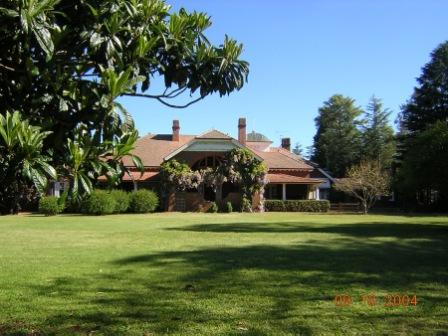
Photo: Palmerston, Armidale

Petersons Wines Armidale Winery and Vineyard has turned one Armidale's historic homes into a luxurious new guesthouse.

Palmerston was built in 1911 by members of the Dangar family, one of the pastoral dynasties that has left an indelible mark across New England's built landscape.

The Dangar dynasty was largely founded by Henry Dangar (1796-1861) supported by brother William.

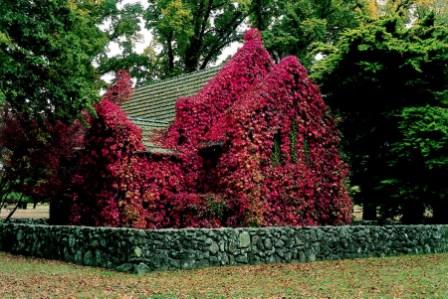
Starting from Neotsfield in the Hunter Valley near Singleton, Henry had acquired over 300,000 acres (121,407 ha) by 1850 spread across New England. This included Gostwyck near Uralla with its beautiful chapel (photo).

In addition to his pastoral interests, Henry acquired town allotments and established inns and stores along the Great North Road to the Liverpool Plains. At Newcastle he had boiling-down works and meat-preserving and tinning works, and in New Zealand he established a steam flour-mill near the wheat farms around Official Bay.

Petersons, a family company already synonymous with quality, award winning wines, has restored Palmerston in line with its original architecture, retaining a historic element but offering contemporary conveniences, like wireless broadband access, heated floors and plasma television to create a unique boutique style getaway.

With seven spacious suites in a fully restored historic home, the guesthouse will cater for couples looking for a romantic and relaxing weekend away, corporate guests passing through Armidale on business, or guests who are in Armidale for a special occasion.
The two acres of gardens surrounding the property are heritage-listed and create a gorgeous view from the drawing room. Walk through the gardens, and you’ll find yourself at Peterson’s cellar door, where you can sample cool climate wines any day of the week. On weekends, you can enjoy a bottle of wine with a cheese platter, or a barbecue lunch on Sundays.

Guest house manager Katrina George said the Guesthouse is designed to give guests the highest level of comfort in a relaxed, spacious and friendly environment.

“We think this Guesthouse is particularly unique to New England,” she said, “and we trust it will be a memorable experience for anyone who stays here.”

Location Details:

Petersons Guesthouse is at Dangarsleigh Road, Armidale about five minutes by car from the Armidale CBD.

Depending on the route you take, Armidale is around six hours from Sydney, five hours from Newcastle, three hours from Port Macquarie, around two and a half hours each from Coffs Harbour and Grafton, four hours from Lismore and four and half hours from Brisbane.

Phone Peterson’s Guesthouse on +61 2 (02) 6772 0422 or email: petersons.armidale@bigpond.com

Monday, September 11, 2006

New England Australia - Aviation


Photo. New England Airways Avro parked at Archerfield, Brisbane c 1933.

New England has had more than its fair share of pioneer aviators. Unfortunately, like so much of New England's history, this has become submerged in the mists of time.

When I started at TAS (The Armidale School), a former senior prefect Sir P G Taylor was one of the school hero's.

Taylor was involved with flying since at least 1916. Perhaps his most famous exploit came in 1935. The story that follows is drawn from Keith Isaacs' ADB entry on Taylor given in the previous link.

Taylor was Kingsford Smith's navigator in the Southern Cross for the King George V jubilee airmail flight (Australia-New Zealand). After flying for six hours, the heavily-laden aircraft had almost reached half-way when part of the centre engine's exhaust manifold broke off and severely damaged the starboard propeller. 'Smithy' closed down the vibrating starboard engine, applied full power to the other two, turned back to Australia and jettisoned the cargo. The oil pressure on the port engine began to fall alarmingly.

Climbing out of the fuselage, Taylor edged his way against the strong slipstream along the engine connecting strut and collected oil from the disabled starboard engine in the casing of a thermos flask. He then transferred it to the port engine. With assistance from the wireless operator, John Stannage, he carried out this procedure six times before the aircraft landed safely at Mascot some nine hours later. For his resourcefulness and courage, Taylor was awarded the Empire Gallantry Medal.

This episode was portrayed in Ken Hall's 1946 film, Smithy, a film I saw later in the TAS Assembly Hall where films were held every Saturday night for the boarders. I was one of a small number of day boys, but always used to go.

The first New England based airline that I have found was called, appropriately enough, New England Airways. It appears that there have in fact been three New England Airways at different points in New England's history.

Headquartered in Lismore, the first New England Airways (NEA) was formed in 1931 by George A Robinson with Sydney solicitor Arthur Allen as chair.

In August 1931 NEA began a bi-weekly Lismore-Archerfield (Brisbane) service, later extended to a Lismore-Mascot (Sydney) service, thus creating a Brisbane- Sydney service. The popularity of the service was such that NEA purchased a tri-motor Avro 10 and extended the service to a daily one.

Flying had real dangers in these early days of civil aviation. On 18 September 1932 an NEA Puss Moth flying from Sydney to Brisbane crashed near Byron Bay. Among those killed was the pioneer Australian aviator Leslie Holden.

The industry was also very unstable in financial terms, with companies emerging, closing or merging all the time. G A Robinson took advantage of this, acquiring other airline assets including those of Murray Valley Aviation as well as Australian National Airlines' (the airline founded by Kingsford Smith) Mascot hangar and workshop and one of its planes. With broadening horizons and national ambitions, New England Airways was renamed Airlines of Australia in 1935. Then, in 1942 the second ANA formed by the Holyman family in 1937 acquired Airlines of Australia, giving ANA a dominant position in Australian civil aviation.

As we shall see later, this first New England Airways established what was to be the dominant pattern in New England civil aviation, regional growth followed by broader expansion, acquisition, and ultimate disappearance.

Thursday, September 07, 2006

New England Australia - Stocktake Historical Posts 7 September 06

Even though this blog has only been going for a relatively short time, I am already up to 43 posts. I thought, therefore, that it might be helpful to you as well as me if provided regular consolidated updates on posts by particular topics.

This first update focuses on the history of New England. Most posts in fact contain some historical material. The following list focuses on the main historical posts. I did not realise until I prepared it just how far the discussion thread has taken me away from my opening historical theme.

Wednesday, September 06, 2006

New England Australia - Preliminary thoughts on history of Theatre in New England


I have so far written two stories on this blog about playwrights with New England connections.

The first story followed the death of Alex Buzo and looked at his life from a personal perspective. The second story looked in part at the life of Bob Herbert.

In that story I said:

"Bob's story reminds me that there is still no history, or at least one that I am aware of, of theatre in New England. This is another significant gap in New England historiography, one that I will write about in another post to try to explain why I think it is important."

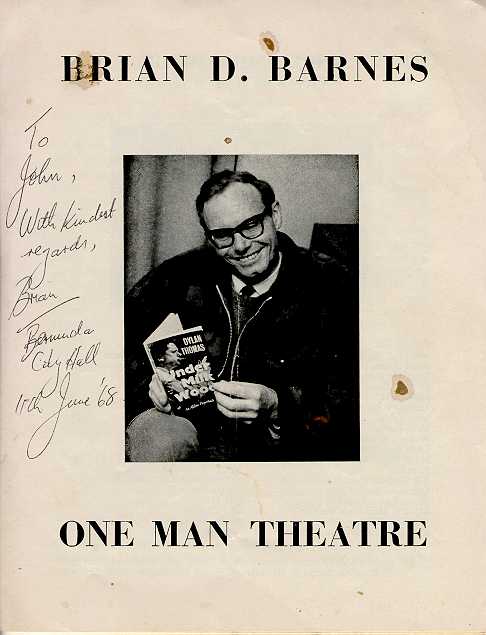
A little later I followed that post up with a story on Personal Reflections, my personal blog, celebrating the 75th birthday of Brian Barnes. Together with Harold Bennett, Brian founded the New England Theatre Centre, the first attempt that I am aware of to establish a fully professional theatre company in regional Australia.

Those who have read the story on Brian Barnes will see that I have now managed to upload one photograph, the cover of his 1968 performance of Under Milkwood in Bermuda. I had seen Brian do this earlier in Armidale.

The limited material I have seen on the history of theatre in Australia, I say limited because this is an area that I have yet to look at in any detail, has a Sydney/Melbourne focus. This is understandable simply because the relatively large population of those centres made them more attractive to performance and performers. However, it is not the end of the story.

We know that there was a thirst for entertainment, we also know that:

  • circuses toured New England regularly from at least the early 1870's
  • there were local theatricals (Harry Clay, for example, apparently began his theatre career with performances in the Singleton area) from fairly early times, but we do not know when or where they began, how they spread
  • individual companies of players such as Clay's toured regional NSW
  • there is a postive but still ill-defined relationship between the spread of schools and schooling and then later of tertiary institutions and the development of theatre in New England
  • there are also almost certainly yet to be defined linkages between broader social and economic trends and changes in theatre in New England.

Just as we have found with New England writers, I suspect that there is a fascinating story here waiting to be told.

Saturday, September 02, 2006

New England Poets Present - 5th Annual Poetry Festival Sydney

I see from the September e-Bulletin from Regional Arts NSW that at least three poets with New England connections - Anthony Lawrence, Yve Louis and Michael Sharkey - are taking part in Sydney activities associated with the 5th Australian Poetry Festival:Between. Good to see New England bringing some culture to Sydney.

Born at Tamworth on 27 April 1957, Anthony Lawrence (and here) has written poetry and fiction. He left school at the age of 16, becoming firstly a jackeroo, and then travelling for several years before returning to New South Wales to become a teacher and writer. Anthony's poems have appeared in many Australian and international literary magazines, including Meanjin, Overland, Poetry Australia, LiNQ. He has won numerous literary awards.

Anthony now lives in Tasmania and is claimed by that state as its own. However, his approach to writing - "I write about nature to define my life", he said in an interview - means that his New England experiences have been an important influence on his work.

Whereas Anthony moved from New England to Tasmania, Yve Louis (and here) is an example of a reverse transfer. Born in Darlinghurst (Sydney) on 10 February 1931 of Jewish and Lithuanian heritage, Yve Louis' first writing was for the ABC's Argonauts' Club.

This actually gives her two linkages with me. I was also born on 10 February if somewhat later and, like Yve, I listened to the Argonauts, glued to the radio from 5 to 6 every week day. Then, if conditions were right, I could switch stations to South Australia and listen to the last half hour all over again!

Few younger Australians would realise just how important the Argonauts were in providing a link to the broader world in areas like New England. The Club began as a national program in 1941. By 1950 there were over 50 000 Club members. It encouraged children's contributions of writing, music, poetry or art and was one of the ABC's most popular children's programs, running six days a week for 28 years, until it was broadcast only on Sundays and was finally discontinued in 1972, a victim of television.

Returning to Yve, she went to school at North Sydney Girls' High School, afterwards working in advertising while also studying by night at Sydney's Independent Theatre. She appeared there in several plays directed by Doris Fitton. Later she worked in radio, and also toured with the Elizabethan Theatre Co as Bubba in a production of Summer of the Seventeenth Doll.

I am not sure when Yve moved to Armidale. She then lived in the Adelaide Hills for five years during the early 'nineties where she became a regular reader at Friendly Street (and active committee member) and was an early participant of the working group, First Draft. With Jeff Guess, she co-edited Friendly Street 18. In 1995 her first collection of poems, Silver from Black, was published in Friendly Street New Poets: One.

Returning to Armidale, Yve edited five editions of the New England Review as well as an anthology, Skylines: New Writing from New England. In 2000 she co-founded Poetzinc, a monthly open reading which encourages local poets, and warmly welcomes all visiting poets. Recent collections by Yve Louis are Lilith's Mirror (1999), Kardoorair Press; and Voyagers (2002), Five Islands Press. Yve's first collection, Silver from Black, may be purchased on-line from the Wakefield Press website.

Michael Sharkey is the third New England poet presenting in Sydney. I have spoken of Michael before, so will not repeat the details.

I do not have full program details for the Festival - there have apparently been some problems with the web site, but understand that Yve and Michael will be reading at the 'Big School' at Sydney Grammar-next to the Museum in College Street-from 1pm till 1.45 on Saturday 9 September. At some point, Michael will also be launching a book by Melbourne poet Simon West.

Wednesday, August 30, 2006

New England, Australia - CWA


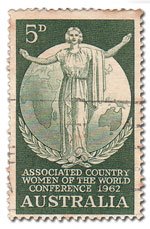
A friend and colleague Noric Dilanchian sent me photographs of two stamps from his collection and challenged me to write stories about them. This is the first story.

The pictured stamp celebrates the 1962 Associated Country Women of the World Conference.

The CWA is the oldest and largest organisation representing the interests of country women. The NSW and Queensland Branches of the CWA were formed in 1922, followed over the next fourteen years by each of the other states and the Northern Territory. A national association was formed in 1945.

Helen Townsend's book, Serving The Country: the history of the Country Women's Association in New South Wales (Doubleday) traces the history of the NSW Branch of the Association from its formation in 1922 through to 1988.

She points out that the public picture of life in country Australia in 1922 was dominated by men. There are glimpses of women, but the stereoptype of the outback wife was very much a background figure - "a stoic little woman, fighting behind her man through drought, flood, fire and economic hardship" (p1).

Helen also notes that most Australian's picture the country woman as the wife of a grazier or a wheat farmer. But country women also included the wives of shearers and farm labourers, small farmer's wives, village and town women, wives of railway workers, aboriginal women. Religions, beliefs, life experiences and standards of living varied tremendously, but all shared certain common problems.

Unlike New Zealand which quickly developed a relatively large number of larger urban centres with significant facilities, the Australian population was much more dispersed, even the larger country centres much smaller than their New Zealand equivalents. When David Drummond, the member for the Northern Tablelands, visited New Zealand in the 1920s he was astonished at the decentralised nature of the population, at the size of communities compared with New England.

Geoffrey Blainey suggested in Tyranny of Distance that this dispersed pattern was a natural outcome of Australia's geography. I have suggested that at least in New England's case, issues associated with the centralisation of economic and political power were important.

Whatever the reason, the dispersed population structures created specific problems for country women in New England and other parts of NSW. These problems were compounded by another feature, the very much larger number of small farms and small to very small farming and mining settlements then as compared to now.

This population structure meant that there were many women remote from each other on farms, others with at least female companionship nearby but distant from the nearest reasonable size town, still more distant from Sydney its greater facilities.

By 1922 cars had started to spread following the development of the cheap and durable Model T Ford by Henry Ford in 1909. In 1915 15,000 cars were imported, of which 10,000 were Model Ts. But while cars were spreading, ownership was limited, with most country families still relying on horses in one way or another over rutted country roads. Those needing to go beyond the nearest town to Sydney or Brisbane then faced a long train or sea trip.

Illness or accident were common, community support structures were limited, leaving women and children especially vulnerable. Helen Townsend quotes one farmer's plea from 1922: "My wife is dying before my eyes . . . . we can't get help for her. She won't leave me and the boys and take a spell in the city."

These needs drove the early founders of the CWA.

From Easter 1922 as branches formed across the state, members decided that they needed somewhere to meet. This lead to the progressive creation of CWA Rest Rooms, places where women could meet, have a cup of tea, feed babies. These Rest Rooms also became a valuable facility for community meetings. It is hard today to realise just how important all this was in days when a trip to town was a major all-day event, when basic facilities for women (men at least had the ubiquitous pub) were lacking.

The growing CWA also focused on health issues for women and children. Baby health centres were created, education programs developed, bush nurses and bush hospitals created. Holiday homes were established where country women could take breaks.

All this development had to be funded. CWA branches ran a variety of fund raising activities including catering for a variety of country and town events, in so doing adding further to the fabric of community life.

In all, the organisation was an enduring success. So, Noric, your stamp has given me an excuse to at least sketch another element in the New England experience.
Monday, August 28, 2006

New England Australia - Writers and Writing Continued


Robert Drewe and Michael Sharkey, New England Regional Art Museum, photo New England Writers Centre.

I mentioned Michael Sharkey in New England Australia - Writers, my first post on New England writers. Michael has sent me a very kind email saying that he likes my new England site: "very classy."

I had not intended to run another immediate post on New England writers and writing, but Michael's email included some interesting material.

Michael pointed me to the AusLit data base, an electronic bibliographic database project currently maintained at the University of Queensland. I mention it here because while I did know it and had referenced it, it is a useful public data base, if most accessible to those in tertiary institutions. It requires a subscription for full access.

Michael also pointed me to another site, one that I knew nothing about, lyrikline, a German based poetry site. A German site? It is actually an international poetry site with poems in four languages. The site also includes poets reading their own poems, although for some reason I have yet to work out I could not download. Les Murray (and here), another New England poet, and Michael were the first Australians to be included.

Subsequently other Australians were included including Peter Skrzynecki, another writer with New England connections, teaching at at Jeogla on the Tablelands, Kunghar on the Tweed River. Peter also completed a BA plus a Master of Letters at the University of New England. You can find out more about Peter's fascinating history here.

Returning to Michael, I had forgotten that he was chair of the New England Writers Centre and had been so since its formal inception in 1993.

The Centre is actually an example of the two definitions of New England that I referred to in early posts, the New England Tablelands and North Western Slopes as compared to the broader New England area covered by the Northern or New England separation movements.

The New England Writers' Centre opened in 1994. Funded by the NSW Ministry for Arts and formally opened in 1964, the Centre is situated in Armidale but serves the New England Tablelands and Northern Slopes from Wee Waa in the west, Bellingen in the east, Tamworth in the south, and Tenterfield in the north.

The inclusion of Bellingen is interesting because the town is actually located on the Bellinger River in the humid coastal zone, not the Tablelands as such. However, Bellingen is only two hours (153 kilometers) away from Armidale and has become a significant centre for those seeking alternative life styles.

The Centre maintains an active program of activities using local writers, while also bringing the best external writers for readings, forums and workshops. The Centre's contact details are:PO Box 1219, Armidale NSW 2350, Email newc@northnet.com.au, Ph 02 6772 2710.

Friday, August 25, 2006

New England Australia - yet still more on writers and writing


When I began this blog I had a particular focus. I wanted to capture elements of New England that I feared were vanishing for ever. So my focus was on the past. But now that I am part way down track, I find an increasing emphasis on the present. This leads to a new focus, revealing to the different parts of New England what others are doing.

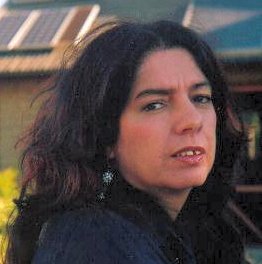
Sophie Masson (photograph) is one of New England's most popular writers. You can find her writings in most Australian book stores.

Sophie was born in Djakarta to French parents on 18 May 1959. She went to school in Sydney at Mount St Benedict College at the same time as my wife, then married and later moved to Armidale with her family for life style reasons. She is a prolific and well published writer with a focus on fantasy/history drawing on her mixed background.

This background is in fact a fascinating one. You can find out more details on Sophie's web site (here), but just to give you a teaser, Sophie writes:

"I don’t just dream fantasy and legend; I live it. Brought up in the cracks between cultures, in the midst of families whose storytelling was in their very blood and bones, whose imaginations could hardly keep up with their strange and extraordinary lives, I was surrounded as a child by amazing riches of experience."

Like Kardoorair Press in Armidale, Catchfirepress is a specialist New England publisher. Located in Newcastle and incorporated in October 1998, it aims to publish writers from the Hunter area in books wholly designed and illustrated there. Feel free to explore their web site; there they have all their books & pamphlets from 1998 through to the present.

This Is Not Art is held in Newcastle over the October long weekend each year and is Australia's premier independent arts and new media festival. This is not Art is dedicated to showcasing the work and ideas not included in other major festivals, highlighting major trends. This year's festival will be held from 28 September to 2 October.